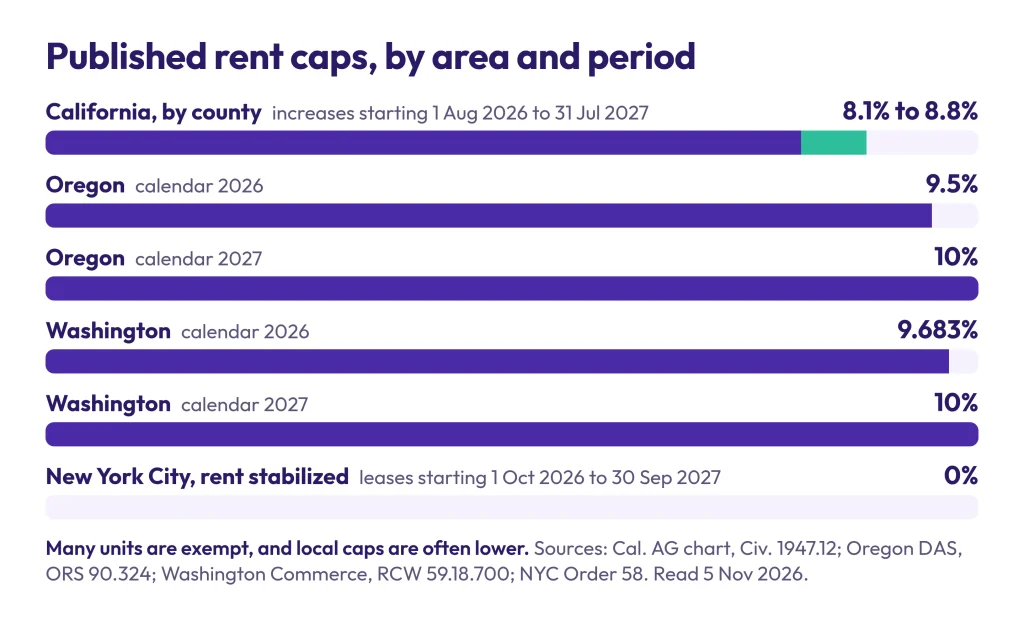
The math is simple: subtract the current rent from the new rent, then divide by the current rent. The law is the hard part. Of the places we read, three states publish a statewide cap: California at 8.1% to 8.8% by county to 31 July 2027, Oregon at 9.5% for 2026 and 10% for 2027, and Washington at 9.683% for 2026 and 10% for 2027. New York City stabilized leases get 0%.
This page is general information, not legal or tax advice. Landlord and tenant law varies by state and city, and changes. Ask the court, your state agency, a lawyer or legal aid about your case.
The calculator turns your figures into dollars and percentages, sets them beside the dated cap for your area, and shows the written notice we read in that statute. It sits with our other guides to rent. Whether a cap reaches your unit is a separate question, and it often turns on the building’s age and who owns it.
Caps depend on the unit, and many units are exempt. This compares your figure with the published percentage. It doesn’t say whether your increase is lawful.
A worked example
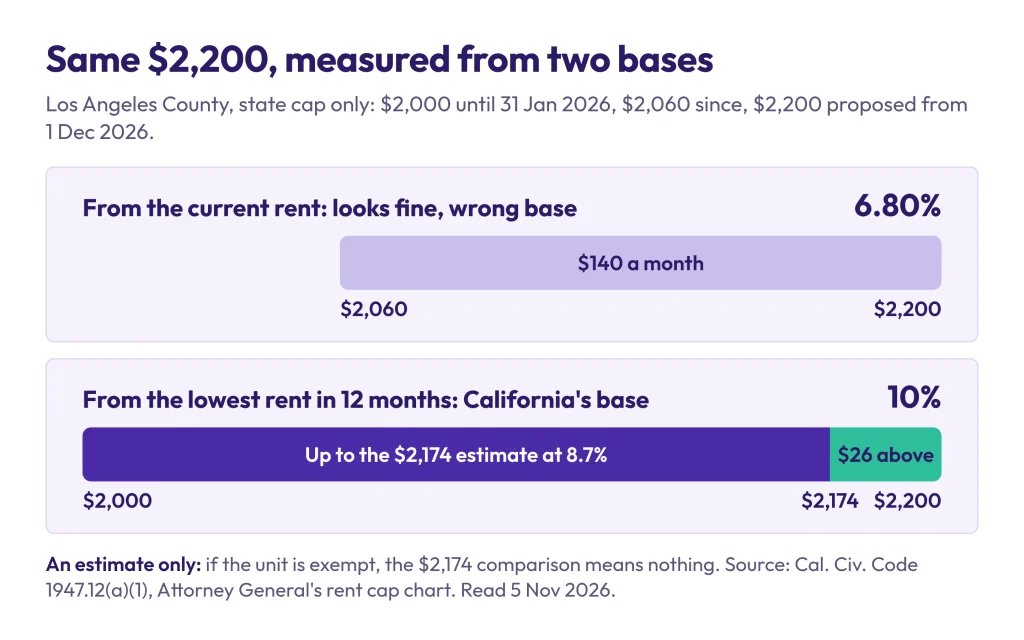
Take a unit in Los Angeles County, covered by the state cap and by no local rule. It rented for $2,000 until 31 January 2026 and has rented for $2,060 since. Someone is looking at $2,200 from 1 December 2026, which would be the second step in 12 months.
- The change: $140 a month, or $1,680 over 12 months. That is 6.80% on the current rent.
- The base: California measures from the lowest rent in the 12 months before the increase, so the base is $2,000, not $2,060 (Civ. Code 1947.12(a)(1)).
- The comparison: the 8.7% figure gives $2,174 as an estimate. $2,200 is $26 above it.
- The notice: $2,200 is exactly 10% on $2,000, so the row that applies is 30 days, not 90 (Civ. Code 827(b)).
Measure the same rise from the current $2,060 and it looks like 6.8%, comfortably under the cap. That is the mistake a plain percentage calculator invites, and it’s why this one asks for the lowest rent as well. If the unit is exempt, the $2,174 comparison means nothing.
The calculator opens on a plainer case: California’s “all other counties”, with the rent unchanged at $1,800 and a new rent of $1,900. That’s $100 a month, or 5.56%, which is $54.80 below the $1,954.80 estimate at 8.6%, with 30 days’ notice.
Rent caps as published
These are the figures in the calculator, read on 5 November 2026. They change every year. California’s Attorney General calls its chart “informational only”, and the statute is what governs.
| Area | Published figure | In force | Source |
|---|---|---|---|
| California: Los Angeles, Orange | 8.7% | Increases starting 1 Aug 2026 to 31 Jul 2027 | AG chart, Civ. 1947.12 |
| California: Riverside, San Bernardino | 8.1% | Same | Same |
| California: San Diego | 8.2% | Same | Same |
| California: Alameda, Contra Costa, Marin, San Francisco, San Mateo | 8.8% | Same | Same |
| California: all other counties | 8.6% | Same | Same |
| Oregon | 9.5% | Calendar 2026 | DAS, ORS 90.324 |
| Oregon | 10% | Calendar 2027 | Same |
| Washington | 9.683% | Calendar 2026 | Commerce, RCW 59.18.700 |
| Washington | 10% | Calendar 2027 | Same |
| New York City, rent stabilized | 0% on one-year and two-year leases | Leases starting 1 Oct 2026 to 30 Sep 2027 | Order 58 |
Oregon’s figures are for ordinary tenancies under ORS 90.323. Manufactured home and marina facilities follow a different line of ORS 90.324, and a facility with more than 30 spaces is at 6%. Washington’s cap expires on 1 July 2040 and California’s on 1 January 2030, each by its own terms. The rest of Washington’s increase rules are in our guide to Washington rental law.
Which year’s figure applies
California answers this: the chart goes by the date the increase starts. Oregon and Washington publish a figure per calendar year, and neither the statute nor the agency page we read says whether the notice date or the start date decides. It matters right now. A 90-day notice served in November 2026 takes effect in February 2027, and the two years’ figures differ by half a point in Oregon and about a third of a point in Washington.
The calculator shows each year as its own choice, so you can see both. If an increase falls between the two figures, ask Oregon Housing and Community Services, which the state’s 2027 notice names for questions, Washington Commerce, or a lawyer.
Who’s outside the cap
For a small owner, this table often matters more than the percentage. Each row is a statute’s list, shortened and read on 5 November 2026: read the section before relying on it.
| Exemption | California | Oregon | Washington |
|---|---|---|---|
| Newer building | Certificate of occupancy within the previous 15 years, unless a mobilehome, 1947.12(d)(4) | First certificate less than 15 years before the notice, 90.323(5)(a) | First certificate 12 or fewer years before the notice, 59.18.710(1)(a) |
| Single house or condo | Exempt only if separately sellable, the owner isn’t a REIT, a corporation, an LLC with a corporate member or a mobilehome park’s management, and the tenants were given the statute’s written notice, (d)(5) | No such exemption in 90.323 | Owner-occupied house, including one where the owner rents out no more than two units or bedrooms, (1)(f) |
| Owner lives on site | A two-unit building where the owner lived in one unit when the tenancy began and still does, and neither is an ADU, (d)(6) | No such exemption in 90.323 | Duplex, triplex or fourplex where the owner lived in one unit when the tenancy began and still does, (1)(g). Sharing a kitchen or bathroom with the owner, (1)(e) |
| Affordable housing | Deed-restricted or subsidized housing, (d)(1) | Regulated or certified housing, on conditions, (5)(b) | Listed public, nonprofit and tax-credit housing, (1)(b)-(d) |
Four things are easy to miss. California’s single-home exemption isn’t automatic: the wording set out in the statute has to reach the tenants, and for a tenancy begun or renewed since 1 July 2020 it must be in the rental agreement. The Oregon section lists no exemption for a small owner, so owning one rental doesn’t change the cap there. Oregon’s exemptions lift only the percentage limit and the next-tenant limit, so the notice, first-year and once-a-year rules still apply (90.323(5)). And Washington’s three owner-occupancy exemptions fall away for a REIT, a corporation or an LLC with a corporate member (59.18.710(2)).
Oregon’s rows on this page come from the official 2025 edition of the statutes, read in an archived copy dated 23 September 2026 because the Legislature’s site wouldn’t open for us. We haven’t read Oregon’s 2026 session laws, so check the live section.
For the other rules that turn on how many units you own, see rules that change with your unit count.
How the 12-month limits work
Read in each statute on 5 November 2026.
| Rule | California | Oregon | Washington |
|---|---|---|---|
| First year | 1947.12 sets no first-year bar | No increase during the first year, 90.323(2)(a) | No increase in the first 12 months, 59.18.700(1)(a)(i) |
| How often | No more than two steps in 12 months if the same tenant stays, (a)(2) | Once in any 12-month period, (2)(c) | Limit applies over any 12-month period. The required notice form says once every 12 months, 59.18.720(3) |
| New tenant | Owner sets the first rent freely once no prior tenant remains, (b) | The section limits increases during a tenancy. After a first-year no-cause ending, (4) limits the next rent too | Rent may change by any amount after the tenant leaves and the tenancy ends, (1)(b) |
| What counts | Gross rental rate; accepted discounts are excluded when finding the lowest rate, (a)(1) | Rent, which excludes deposits and listed fees and utility or service charges, ORS 90.100 | Rent includes recurring and periodic charges, 59.18.720(3). Enter the total |
The calculator measures from the lowest rent for California, as the statute says. Oregon’s and Washington’s sections don’t name a base, so it uses the same figure there as an estimate. That only changes the answer if the rent rose in the past 12 months. For New York City and for a percentage you type in, it uses the current rent.
Written notice before a raise
There is no national notice period. The calculator shows the California, Oregon and Washington figures; the table adds what else we read, as of 5 November 2026. How to word and deliver it is covered in our guide to what a rent increase letter must say.
| Place | Notice as read | Statute |
|---|---|---|
| California | 30 days if 10% or less, alone or with other increases in 12 months; 90 days if more. More time if mailed. Month-to-month and shorter tenancies | Civ. 827(b) |
| Oregon | 90 days; 7 days for week-to-week, which sits outside the section’s first-year, once-a-year and percentage limits. The notice must state the increase, the new rent, the date and any exemption facts | ORS 90.323 |
| Washington | 90 days, and no rise before the rental term ends. 30 days where a subsidized rent is based on income or the household’s circumstances. Set form required, except for those subsidized rents | RCW 59.18.140(3), 59.18.720 |
| New York | For a renewal rise of 5% or more: 30, 60 or 90 days by length of occupancy or lease term. Late notice keeps the old terms running until the period ends | RPL 226-c |
| Virginia | Owners of more than 4 units, or over 10% interest in more than 4: 60 days before the term ends, for tenants with a renewal option or an automatic renewal clause. 90 days from 1 Jul 2027. Doesn’t cover smaller owners | 55.1-1204(K) |
| Texas, Florida, Arizona, Pennsylvania | The chapters we read set no rent increase notice | Tex. Prop. ch. 91, ch. 92, Fla. Stat. ch. 83 Part II, A.R.S. title 33 ch. 10, Pa. Act of 1951 |
Everywhere else: not confirmed. A lease can also set its own terms. California’s section 827, for one, is written for week-to-week and month-to-month tenancies and those of shorter periods, so if there’s a fixed-term lease, read it first. If the new rent starts mid-month, our prorated rent calculator splits the month.
City and county rules
Local caps are often lower than the state’s, and they apply only to the units that local law covers. These aren’t in the calculator’s list, but you can type one in as your own percentage. The California rows come from the Attorney General’s local chart, read on 5 November 2026, which says to confirm with the city or county.
| Place | Figure | Period | Source |
|---|---|---|---|
| City of Los Angeles | 3%, on units under the city’s rent ordinance. The city’s housing department adds "Pending final Council approval" | AG chart: 1 Jul 2026 to 30 Jun 2027. The department: through 30 Jun 2027, for increases effective from 2 Feb 2026 | AG local chart, LAHD |
| Los Angeles County, unincorporated | 1.919%; 2.919% for some buildings of 10 or fewer units owned by a small property landlord | 1 Jul 2026 to 30 Jun 2027 | Same |
| San Francisco | 1.6%, on units with a certificate of occupancy before 13 Jun 1979 | 1 Mar 2026 to 28 Feb 2027 | Same |
| Oakland | 2.3%, on units with a certificate of occupancy before 1 Jan 1983 | 1 Aug 2026 to 31 Jul 2027 | Same |
| San Jose | 5%, in buildings of 3 or more units with a certificate of occupancy on or before 7 Sep 1979 | Every 12 months | Same |
| Washington, DC, rent-controlled units | 4.1%; 2.1% for registered elderly or disabled tenants | 1 May 2026 to 30 Apr 2027 | DC Office of the Tenant Advocate |
| St. Paul, Minnesota | 3% in 12 months. Buildings with a first certificate of occupancy after 2004 are excepted | Standing rule | City of St. Paul |
| Portland, Maine | 2.2%. Owner-occupied buildings of 2 to 4 units are exempt | Calendar 2026 | City FAQ, version 24 Oct 2025 |
New York’s Good Cause law works differently: it isn’t a cap. In New York City, a rise above the local rent standard is presumed unreasonable, and that standard is 8.38% as of 4 May 2026, with the court deciding (RPL 216). In the city, owners of 10 or fewer units in the state can be outside it, and the test looks through companies to the people who own them (RPL 211(3)). Other New York towns have to opt in. The state’s notice lists them, with each one’s rent and small-landlord thresholds.
Some California cities voted on rent measures on 3 November 2026. Those counts aren’t certified, so we state no result. Check with the city.
Where we read no cap
Three states bar local rent control in the sections we read: Florida, s. 125.0103 (also s. 166.043), Arizona, 33-1329 and Colorado, 38-12-301 (2025 edition; we haven’t read Colorado’s 2026 session laws). Each section has its own limits, so read it. For Texas, Virginia and Pennsylvania, the chapters we read set no cap, which says nothing of other chapters or local rules. For every other state, a cap is not confirmed here. Our page on states with rent control goes further.
No cap doesn’t mean no limit. Some statutes bar a rise as retaliation: California for 180 days after listed tenant acts (Civ. 1942.5), Texas for 6 months (Prop. 92.331). The federal Fair Housing Act bars different rental terms because of a protected class, with narrow exemptions for some small owners (42 U.S.C. 3604(b), 3603(b)). A voucher tenancy has its own rules: see how Section 8 works for landlords.
What happens above a cap
As read in each statute on 5 November 2026.
- California: the tenant can sue for an injunction and the excess. A court may award fees, and up to three times the excess for willful conduct, oppression, fraud or malice. The Attorney General and the city attorney or county counsel can enforce it. The time limit is three years, and a waiver is void (1947.12(k), (l)).
- Oregon: three months’ rent plus the tenant’s actual damages (90.323(6)).
- Washington: the tenant gives a written demand to fix the increase, and may end the rental agreement before the increase takes effect, on 20 days’ written notice. A court awards the excess, up to three months of the unlawful charges, and fees. The Attorney General can seek up to $7,500 per violation. A landlord can’t report the tenant to a screening service for not paying the unlawful part (59.18.700).
Next step
Run the numbers, then check in this order. Does a local rule cover the unit? Does an exemption apply, and was any required notice given? When did the rent last change, and what was the lowest figure in the past 12 months? Then look up the notice period in the lease and the statute.
If you’re a landlord unsure about an exemption or a figure near a cap, ask a lawyer before the notice goes out. If you’re a tenant who thinks a rise is too high, the city’s rent office, your state agency or legal aid can look at your unit. In California, the Attorney General’s chart points to lawhelpca.org.
Sources checked on 5 November 2026.
Formulas and sources
- New monthly rent: Arithmetic on the reader's own entries, no outside figure
- Change per month: Arithmetic on the reader's own entries, no outside figure
- Change as a share of current rent: Arithmetic on the reader's own entries, no outside figure
- Change over 12 months: Arithmetic on the reader's own entries, no outside figure
- Change from the lowest rent: Arithmetic on the reader's own entries, no outside figure
- Published percentage compared: California Civil Code 1947.12(a)
- What was compared: Arithmetic on the reader's own entries, no outside figure
- Rent the percentage is measured from: California Civil Code 1947.12(a)
- Rent at the published percentage, rounded down to the cent: California Civil Code 1947.12(a)
- Room below that rent: Arithmetic on the reader's own entries, no outside figure
- Above that rent by: Arithmetic on the reader's own entries, no outside figure
- Minimum written notice as read: California Civil Code 827(b); ORS 90.323(2)(b); RCW 59.18.140(3)(a)
- California, Los Angeles and Orange, increases starting 1 Aug 2026 to 31 Jul 2027, percent (8.7, as of 2026-11-05): California Attorney General: rent caps chart, informational
- California, Riverside and San Bernardino, same period, percent (8.1, as of 2026-11-05): California Attorney General: rent caps chart, informational
- California, San Diego, same period, percent (8.2, as of 2026-11-05): California Attorney General: rent caps chart, informational
- California, San Francisco area counties, same period, percent (8.8, as of 2026-11-05): California Attorney General: rent caps chart, informational
- California, all other counties, same period, percent (8.6, as of 2026-11-05): California Attorney General: rent caps chart, informational
- Oregon, calendar 2026, percent (9.5, as of 2026-11-05): Oregon DAS: rent stabilization, maximum annual increase
- Oregon, calendar 2027, percent (10, as of 2026-11-05): Oregon DAS: rent stabilization, maximum annual increase
- Washington, calendar 2026, percent (9.683, as of 2026-11-05): Washington Department of Commerce: HB 1217 landlord resource center
- Washington, calendar 2027, percent (10, as of 2026-11-05): Washington Department of Commerce: HB 1217 landlord resource center
- New York City stabilized leases, Order 58, percent (0, as of 2026-11-05): NYC Rent Guidelines Board: Order 58, 2026-27
Sources
- California Attorney General: rent increase caps chart
- California Civil Code 1947.12
- California Civil Code 827
- California Civil Code 1942.5
- Oregon Revised Statutes chapter 90, 2025 edition
- Oregon DAS: rent stabilization
- Oregon DAS: annual maximum rent increase for 2027, 28 Sep 2026
- RCW 59.18.700
- RCW 59.18.710
- RCW 59.18.720
- RCW 59.18.140
- Washington Commerce: HB 1217 landlord resource center
- NYC Rent Guidelines Board: Order 58
- NYC HPD: Good Cause Eviction
- New York DHCR: Good Cause Eviction law notice, Aug 2026
- New York Real Property Law 211
- New York Real Property Law 216
- New York Real Property Law 226-c
- Virginia Code 55.1-1204
- DC Office of the Tenant Advocate: rent adjustment, 2026
- City of St. Paul: rent stabilization
- City of Portland, Maine: rent control FAQ, version 2025.10.24
- Florida Statutes 125.0103
- Arizona Revised Statutes 33-1329
- Colorado Revised Statutes 38-12-301, 2025 edition
- Texas Property Code chapter 91
- Texas Property Code chapter 92
- Pennsylvania Landlord and Tenant Act of 1951
- 42 U.S.C. 3604
- Florida Statutes chapter 83
- Los Angeles Housing Department: home page RSO notice
- Arizona Revised Statutes title 33