You become a Section 8 landlord one tenancy at a time. The federal rules we read set no license or national sign-up. A family with a Housing Choice Voucher (the program’s current name) picks your unit, the local public housing agency (PHA) inspects it and checks the rent, you sign a lease and a contract with the PHA, and the PHA pays part of the rent to you each month. The federal voucher rules don’t require you to take part, though some state and city laws limit your right to refuse.
This page is general information, not legal or tax advice. Landlord and tenant law varies by state and city, and changes. Ask the court, your state agency, a lawyer or legal aid about your case.
It’s part of our Becoming a Landlord guide. Below are the steps in order, how the rent split works, and what HUD’s 2026 funding warnings mean for anyone counting on a voucher tenant. Landlord Rulebook sells nothing and refers no one.
| The short version | The rule | Source |
|---|---|---|
| Duty to join | None in the federal voucher rules. State and local laws can differ | 24 CFR 982.302(b), 982.53(d) |
| First lease | At least one year, unless the PHA approves less. No rent raise during it | 982.309(a) |
| First inspection | No charge to the owner | 982.405(h) |
| Rent ceiling | The PHA’s “reasonable rent”, set against similar unassisted units | 982.507 |
| Repairs the PHA cites | 24 hours if life-threatening, otherwise 30 calendar days or an approved extension | 982.404(a)(3) |
| Contract deadline | Signed within 60 calendar days of the lease start, or it’s void unless HUD grants an extension | 982.305(c) |
What the program is
“Section 8” here means the tenant-based Housing Choice Voucher program. The aid follows the family, HUD funds it, and a local PHA runs it. Three parties hold duties. HUD’s landlord fact sheet describes the split: the PHA checks the family’s income and the unit, the landlord provides decent housing at a reasonable rent, and the tenant follows the lease and pays their share on time.
You’ll deal with one contract you may not have seen before: the Housing Assistance Payments (HAP) contract, between you and the PHA. The monthly subsidy is called the HAP too. Project-based vouchers, which attach to a building rather than a family, follow a different process and aren’t covered here.
Who can’t take part
Check these before you spend time on the steps. Nothing in the rule gives an owner a right to participate (982.306(e)).
- Your own home. A unit occupied by its owner, or by anyone with an interest in it, can’t be assisted (982.352(a)(6)). The other side of a duplex you live in isn’t barred by that line.
- Close relatives. When a family first gets assistance for a unit, the PHA must not approve it if the owner is the parent, child, grandparent, grandchild, sister or brother of a family member, unless approval is a reasonable accommodation for a person with a disability (982.306(d)).
- Barred owners. The PHA must refuse an owner who is debarred or suspended from federal programs. It may also refuse an owner who has unpaid state or local real estate taxes, fines or assessments, a history of renting units that fail housing codes, or past HAP contract violations (982.306(a), (c)).
The steps, in order
HUD’s own landlord handout gives four steps. This is the same path in more detail. Your PHA may add its own owner packet and forms, because HUD says PHAs have flexibility in how they run the program.
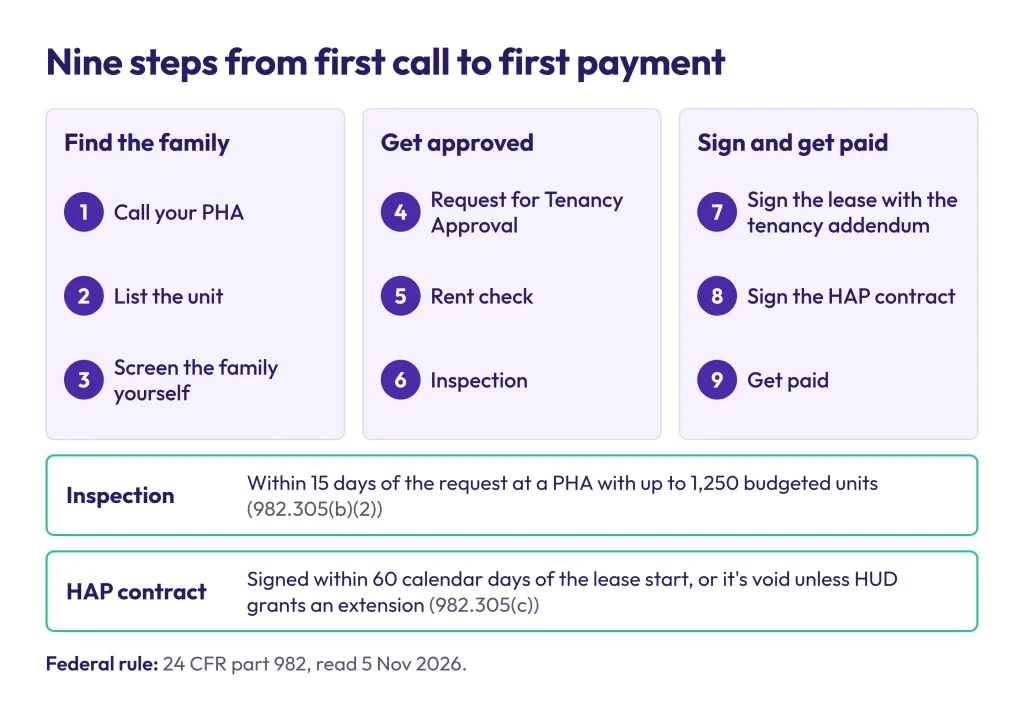
- Call your PHA. HUD’s PHA contact list goes by state. Some areas have more than one agency. Ask the questions in the last section of this page before you do anything else.
- List the unit. HUD says the PHA may explain how to post vacancies and which local sites are used.
- Screen the family yourself. A voucher means the PHA found the family eligible for aid, not that they suit your unit. Screening is the owner’s job, and the PHA isn’t liable for a family’s behavior (982.307(a)). The PHA must give you the family’s current and prior addresses and the landlords’ names and addresses it has on file. HUD says to screen voucher tenants as you would any other tenant; our page on the legal steps in tenant screening covers the rest.
- Complete the Request for Tenancy Approval. This is form HUD-52517. The family submits it with a copy of the lease, in the way the PHA requires (982.302(c)-(d)). A voucher’s first term must be at least 60 days, and the clock stops while the request is pending (982.303).
- Rent check. The PHA compares your rent with unassisted units on location, quality, size, type, age, amenities, services and utilities (982.507(b)).
- Inspection. A PHA with up to 1,250 budgeted units must inspect and report within 15 days of the request. Larger PHAs must act within a reasonable time, and within 15 days where practicable (982.305(b)(2)). The clock stops while the unit isn’t available. Some PHAs can approve a unit with only non-life-threatening problems, or rely on another program’s inspection from the past 24 months (982.305(f), 982.405(j), 982.406(e)). Ask whether yours does.
- Sign the lease with the tenancy addendum. If you use a standard lease for other tenants, you use it here too, and the addendum (HUD-52641-A) goes in word for word (982.308(b), (f)). The tenant can enforce it against you, and it overrides anything else in the lease. Units built before 1978 also need the lead paint disclosure (982.305(b)(1)(ii)).
- Sign the HAP contract. Form HUD-52641 must be used word for word, apart from a few additions the PHA may make. The copy on HUD’s site carries a 10/2026 edition date, so check that yours matches. HUD’s forms page also lists an IRS W-9.
- Get paid. No HAP is paid until the contract is signed. If it’s signed within the 60 days, the PHA pays back to the lease start. The first month is prorated, and the family pays you its share directly.
On the standard path, the inspection, signed lease and PHA approval must all come before the lease term begins (982.305(b)(1)). That’s why the PHA’s approval date matters before keys change hands.

What you’ll actually be paid
Your rent has to clear three separate tests.
- Reasonable rent. Rent to owner may never exceed the PHA’s latest reasonable-rent figure, and each monthly payment you accept certifies that it’s no higher than you charge for comparable unassisted units on the premises (982.507(a)(4), (d)).
- The payment standard. This is the most the PHA will count toward its subsidy for a unit size. PHAs generally set it at 90% to 110% of HUD’s Fair Market Rent (982.503). The family’s standard is the lower of the amount for its voucher size and for your unit’s size (982.505(c)(1)). Ask the PHA for its schedule. HUD’s Fair Market Rents are generally set at the 40th percentile rent (24 CFR 888.113(b)), so they aren’t a market average, and in some metro areas they’re set by ZIP code.
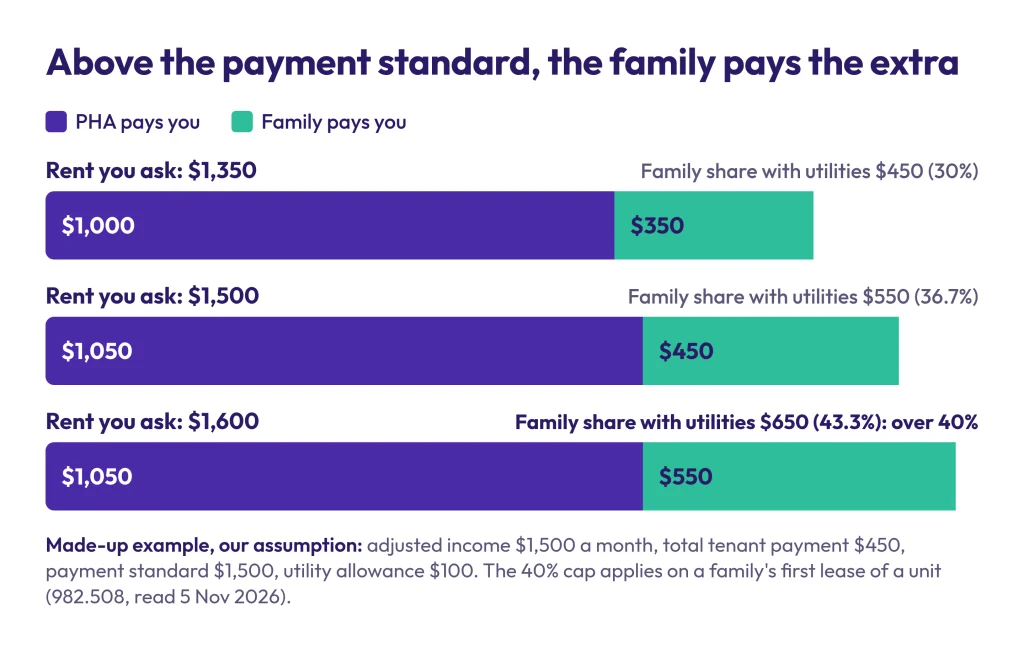
- The 40% cap. On a family’s first lease of a unit, if gross rent (rent plus the PHA’s utility allowance) is above the payment standard, the family’s share can’t exceed 40% of its adjusted monthly income (982.508).
The subsidy is the lower of the payment standard or gross rent, minus the total tenant payment (982.505(b)). That payment is usually 30% of adjusted monthly income, though it’s the highest of several amounts, including 10% of gross monthly income and any minimum rent (24 CFR 5.628). This example uses made-up numbers, our assumption: adjusted income of $1,500 a month, a total tenant payment of $450, a payment standard of $1,500 and a $100 utility allowance.
| Rent you ask | Gross rent | PHA pays you | Family pays you | Family share with utilities | Result |
|---|---|---|---|---|---|
| $1,350 | $1,450 | $1,000 | $350 | $450 (30%) | Within the cap |
| $1,500 | $1,600 | $1,050 | $450 | $550 (36.7%) | Within the cap |
| $1,600 | $1,700 | $1,050 | $550 | $650 (43.3%) | Over 40%: the PHA can’t approve it as a first lease |
Each row still has to pass the reasonable-rent test. The PHA’s payment stops rising once gross rent reaches the payment standard, so every extra dollar after that falls on the family. In this example the most the cap allows is a $1,550 rent. If a tenant’s income falls for good, HUD says the PHA can pay a larger portion.
Three limits apply to the money after move-in.
- No side payments. You can’t demand or accept more than the family’s share of the rent, and any excess goes back at once (982.451(b)(4)). Nor can you charge extra for items customarily included in rent locally or free to unsubsidized tenants on the premises (982.510(c)).
- Rent increases. None during the initial term. After that, tell the PHA at least 60 days before a change (982.308(g)(4)), and the PHA must redetermine reasonable rent first (982.507(a)(2)). A state or city rent cap can apply as well. Our rent increase calculator sets a figure beside the published caps.
- Deposits. You may collect one, but the PHA may bar deposits above private market practice or above what you charge unassisted tenants (982.313). At move-out you owe a written list of charges and a prompt refund of the balance, and your state’s deadline applies. The PHA doesn’t pay other claims against the family (HAP contract, Part B, section 7).
Inspections, and the change coming in February
The unit must meet the standard at the start and for as long as you receive payments. The PHA inspects before the first lease, then at least every two years, or every three at a small rural PHA (982.405(a)-(b)). It also inspects when a family or official reports a problem: within 24 hours if life-threatening, 15 days if not (982.405(d)).
The standard itself is changing. Under Notice PIH 2026-18 (15 July 2026), PHAs may keep using the older Housing Quality Standards until 1 February 2027, and must move to HUD’s newer NSPIRE standards by that date. HUD’s landlord handout still lists the older 13 items, and some PHAs have already switched, so your first inspection question is which standard yours uses today.
- What NSPIRE drops. HUD says it removes the “Site and Neighborhood” unit requirement and subjective opinions on housekeeping and cosmetics. Inspections stay pass or fail with no score.
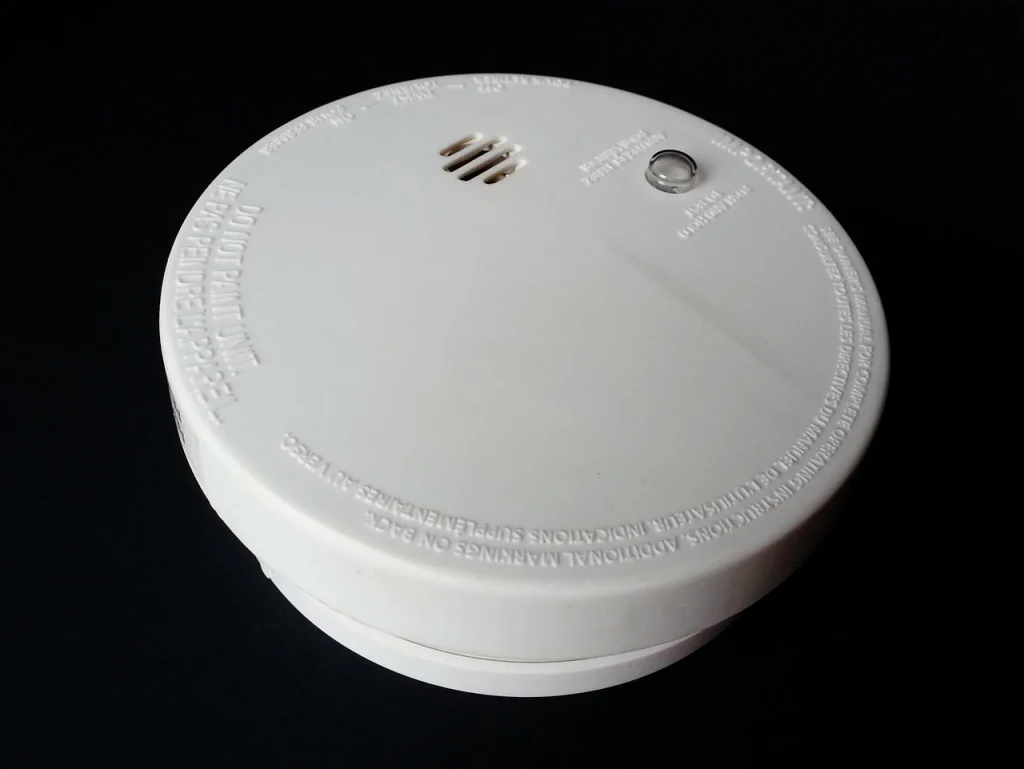
- Smoke alarms, under either standard. Since 29 December 2024 they must be hardwired or sealed 10-year battery devices, HUD’s notice says. Carbon monoxide alarms have been inspectable since 27 December 2022. HUD says neither is on the old HUD-52580 forms, so don’t treat that checklist as the full list.
- Lead paint. Under NSPIRE, for pre-1978 housing where a child under 6 lives or is expected to live, the unit, common areas and exterior painted surfaces get a visual check. The separate lead safety rule in 24 CFR part 35 still applies, with its own methods.
- What’s looked at. Only the assisted unit and the common and exterior areas that serve it (24 CFR 5.705(a)(2), quoted in the notice).
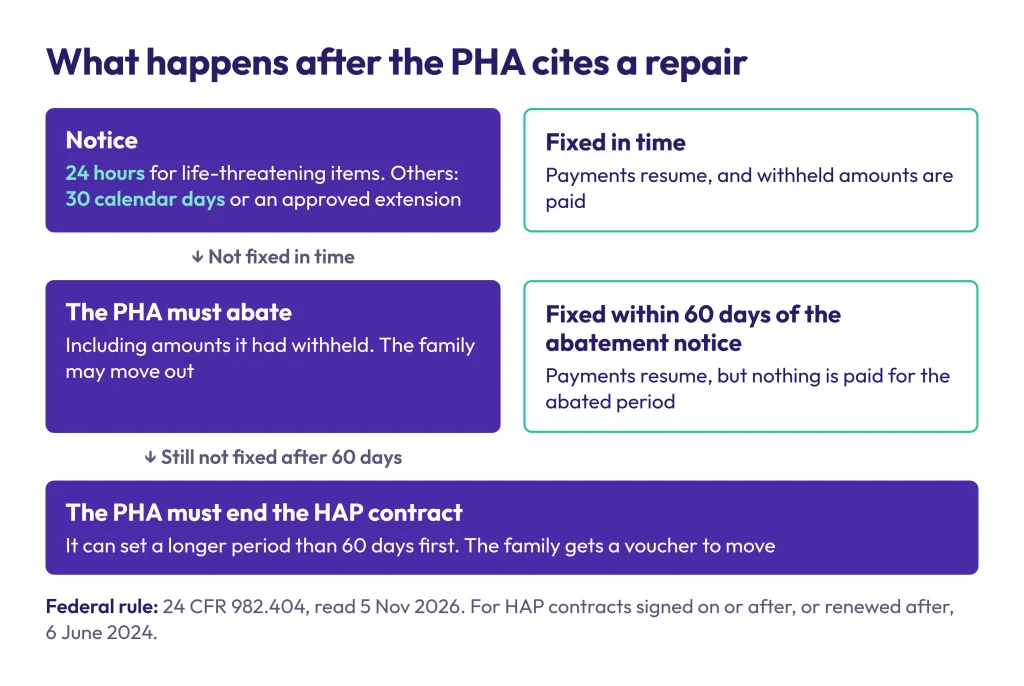
Under HAP contracts signed on or after, or renewed after, 6 June 2024, a cited repair runs on this track (982.404):
| Stage | What happens |
|---|---|
| Notice | Fix life-threatening items in 24 hours, others in 30 calendar days or an approved extension. The PHA may withhold payments once it gives notice |
| Fixed in time | Payments resume, and withheld amounts are paid |
| Not fixed in time | The PHA must abate, including amounts it had withheld. The family may move out |
| Fixed within 60 days of the abatement notice | Payments resume, but nothing is paid for the abated period |
| Still not fixed after 60 days | The PHA must end the HAP contract, though it can set a longer period than 60 days first. The family gets a voucher to move |
You can’t evict a family because payments were withheld or abated (982.404(d)(3)). If the family caused the problem beyond ordinary use, the PHA may waive your repair duty and pursue the family instead (982.404(a)(4)). A failed reinspection of something you said was fixed can bring a reasonable fee, which you can’t pass to the family (982.405(h)). HUD set no dollar figure, so ask your PHA.
How reliable the money is right now
HUD’s landlord sheet calls the payments “timely and dependable”. HUD’s own letters to PHAs paint a tighter picture for 2026.
- On 22 December 2025 HUD wrote that many PHAs “are now on pace to see significant funding shortfalls again in 2026”.
- After the February 2026 funding law it wrote that it “cannot guarantee that funding will be available to resolve all shortfall needs”. It encouraged PHAs to consider stopping new vouchers, with exceptions, and cutting payment standards. PHAs that received 2025 shortfall money may issue vouchers only in very limited cases until HUD releases them.
- HUD’s June 2026 funding notice estimated the 2026 renewal proration at 100%, subject to change. That doesn’t settle it for every agency: HUD’s letter says some PHAs’ funding may fall short even at a high proration.
- For fiscal 2027, the National Low Income Housing Coalition reports a stopgap through 11 December. We found no full-year HUD bill as of 6 November 2026.
Delays have happened. During the 2025 federal shutdown, Georgia’s housing agency wrote that it issued its remaining November payments on 5 December 2025, once funds arrived. We have no national count of late payments, and we can’t say what your PHA’s position is. Here’s what the rules say if money runs short.
- You can’t pass the gap to the tenant. The family isn’t responsible for the HAP portion. A PHA’s failure to pay isn’t a lease violation, and you may not end the tenancy for it during the lease term (982.310(b)).
- Late fees from the PHA are limited. After the first two months, the HAP contract allows penalties only if they fit local practice, you charge them to assisted and unassisted tenants alike, and you charge the tenant for late family rent. None is owed if HUD finds the delay was beyond the PHA’s control, or if payment was held back as a remedy against you (982.451(b)(5); HAP contract, Part B, section 7).
- The contract can end for lack of funds. The PHA may terminate it if funding is insufficient (982.454). Separately, it ends automatically 180 calendar days after the last payment to you (982.455).
- A cut payment standard hits new tenants first. It applies at once to new admissions and movers. For families who stay, HUD’s cost-savings notice says not before two years, with 12 months’ written notice (982.505(c)(3)), unless a PHA in financial trouble gets a waiver. Under the formula above, a cut moves more of the rent onto the family.
Do you have to accept vouchers?
The voucher rules don’t force you: a family requests approval if “the owner is willing to lease the unit under the program” (982.302(b)). HUD says that taking one voucher tenant doesn’t oblige you to take others. But Part 982 doesn’t pre-empt state or local laws that bar discrimination against voucher holders (982.53(d)). In those places a “No Section 8” ad or a flat refusal can itself be the violation. One federal exception covers some buildings: a low-income housing tax credit agreement must bar refusing to lease to a voucher holder because of that status (26 U.S.C. 42(h)(6)(B)(iv)).
Whether you’re covered often depends on how many units you own, which is why our page on rules that change with unit counts matters here. These rows were read in the statute or the state agency’s page on 6 November 2026. They aren’t a complete list. The Poverty & Race Research Action Council’s March 2026 appendix, a secondary source we used only as a map, lists 19 states, DC and Guam. Any state not shown here is not confirmed, and many cities and counties have laws of their own.
| Where | Vouchers covered? | Small-owner or other limit, as read | Source, read 6 Nov 2026 |
|---|---|---|---|
| California | Yes. “Source of income” names Section 8 vouchers | Income tests must rest on the tenant’s portion of the rent. A credit history check must come with an option to show other proof of ability to pay. An owner-occupied single-family house taking one roomer or boarder may refuse, but can’t publish a discriminatory ad | Gov. Code 12955(o), (p), 12927(c)(2)(A); Civil Rights Department |
| Colorado | Source of income covers government assistance | The refusal and ad rules don’t apply to a landlord with 3 or fewer units. An owner of 5 or fewer single-family rentals and no more than 5 units in all needn’t accept vouchers for those homes. Credit checks are allowed if run on every applicant | C.R.S. 24-34-501(4.5), 24-34-502(1)(l)-(p), (1.5), (1.7), 2026 edition |
| Delaware | Source of income includes government rental payments. Start not confirmed: the 2024 act behind the voucher rules begins on the later of 1 Jan 2026 or a state housing authority notice in the Register of Regulations, and we didn’t find that notice. Ask the Delaware State Housing Authority | Owner-occupied buildings of up to 4 families are exempt, except from the ad rule. Income and credit tests stay if commercially reasonable. A landlord may deny if a PHA fails the set processing sequence. The act expires 31 Dec 2028, and the code’s version from that date says landlords needn’t participate | 6 Del. C. 4602(29), 4603(b), 4607(e), (h); 25 Del. C. 5116(e); 84 Del. Laws c. 358, sections 4, 5 |
| District of Columbia | Yes, Section 8 is named as a source of income | Exempt: an owner-occupied building of up to 2 families, or up to 4 where the owner expects to share a kitchen or bath with the tenant. Also an owner of no more than 3 single-family homes renting one without a broker or a discriminatory ad | D.C. Code 2-1402.21(e), 2-1402.24 |
| Illinois | Yes, the state agency names vouchers | Exempt from the refusal rule, not the ad rule: a building of up to 4 families where the owner lives, and rooms in a private home where the owner or family lives. The agency says income tests may count only the tenant’s portion | Dept. of Human Rights FAQ; 775 ILCS 5/3-106(B), (C), read in the General Assembly’s official statute repository |
| Maryland | Yes, federal vouchers are named | For vouchers, exempts rooms in the owner’s principal residence and apartments in a building of up to 5 rental units that’s the owner’s principal residence. A single-family home rented without a broker or a discriminatory ad is also exempt | State Gov’t 20-701(j), 20-704(a), 20-705 |
| New Jersey | Yes, Section 8 is named | Income tests must rest only on the tenant’s portion of the rent. The act doesn’t reach one flat in a two-family home where the owner lives, or a room in a one-family home occupied by the owner or occupant, unless it’s publicly assisted housing | P.L.2025, c.251 (approved 12 Jan 2026, effective at once), amending N.J.S.A. 10:5-5(n), 10:5-12(g); Division on Civil Rights fact sheet (2020) |
| New York | Lawful source of income is protected, and the state defines it to include vouchers | An owner-occupied two-family building is exempt unless the ad rule is broken. A room rented by the occupant or a resident owner is exempt. NYC law not read | Exec. Law 292(36), 296(5)(a) |
| Virginia | “Source of funds” is protected and includes subsidy programs | An owner of 4 or fewer rental units in Virginia is exempt, unless they hold over 10% of more than 4 units there. A landlord may deny if the source isn’t approved within 15 days of the tenancy request | Va. Code 36-96.1:1, 36-96.3, 36-96.2(I), (J) |
| Washington | Source of income includes housing assistance | No unit-count limit in the section. A narrow exception applies where required inspection repairs exceed $1,500 by written estimate and other conditions are met. Income tests subtract the subsidy from rent | RCW 59.18.255 |
HUD has withdrawn two federal guidance items on source of income, both effective in September 2025: a February 2024 testing memo and a November 2024 guidance document. That changes HUD’s guidance, not the law: the state and local laws above stand on their own text, and 982.53(d) still leaves them in force. Where a law applies, it doesn’t usually stop you screening: Illinois, for one, tells providers to screen case by case and treat all applicants the same way, but not to refuse them for holding a subsidy.
Ending a voucher tenancy
Voucher tenants can be evicted, as HUD points out. But the program adds limits on top of state law, and they’re in the addendum you sign.
- Grounds. During the lease, including extensions, you may end the tenancy only for a serious or repeated lease violation, which includes not paying the family’s own share, a violation of law tied to the tenant’s use of the unit, or other good cause (982.310(a)). The lease must also allow termination for listed criminal activity (982.310(c)).
- The first term is narrower. Good cause then has to rest on something the family did or failed to do. Selling, renovating, moving in yourself or wanting more rent don’t qualify (982.310(d)(2)).
- Notice. You must give written notice of the grounds at or before the start of the eviction action, and give the PHA a copy of any eviction notice (982.310(e)). State and local notice rules apply too.
- Court only. You may evict only by a court action (982.310(f)). Lockouts and utility shutoffs aren’t part of the process.
- Survivors. Protections for victims of domestic violence, dating violence, sexual assault and stalking apply (982.53(e), 24 CFR part 5, subpart L).
One federal notice rule is unsettled. 15 U.S.C. 9058(c), from the CARES Act, requires 30 days’ notice to vacate at covered properties, a group that includes those in listed federal housing programs. Arizona’s Court of Appeals held on 12 June 2026 that the notice requirement has expired, while saying most state courts have held otherwise. Ask a lawyer or the court which reading applies where you are. Our guide to how a lawful eviction works covers the general process.
Stop and get a lawyer before serving any notice on a voucher tenant, especially during the first term or while PHA payments are late. If you’re a tenant who has received a notice, tell the PHA right away and contact the court or legal aid.
Claims worth checking
You may see lines like these on seller and blog pages. Here’s what we found when we looked for a primary source.
| The claim | What we found |
|---|---|
| “Guaranteed rent” | We found no guarantee. HUD’s own letters warn of shortfalls, and the family owes only its share |
| “The voucher pays 70% of the rent” | There’s no 70% rule. The split depends on income, rent and the payment standard, as in the table above |
| “Section 8 pays above market” | The rent is capped at the reasonable rent for comparable unassisted units |
| “You sign up with HUD” | You deal with the local PHA. HUD funds and oversees it |
| “Voucher tenants are worse tenants” | HUD says no documented statistics show that, and its sheet cites no data. Screening is yours either way |
Your next step
Before you list anything, call the PHA that serves your address, using HUD’s contact page, and ask:
- Are you issuing new vouchers now, and are families looking in my area?
- What’s your current payment standard and utility allowance for this unit size?
- Are you inspecting under NSPIRE or the older standard, and how soon can you inspect?
- Do you use the non-life-threatening or alternative inspection options?
- What’s your usual time from request to signed HAP contract, and when in the month do you pay?
- Do you have an owner packet or forms of your own?
Then read the HAP contract and tenancy addendum in full, and check your state and city voucher rules. New to renting altogether? Start with how to become a landlord.
Sources checked on 6 November 2026.
Sources
- 24 CFR part 982, Section 8 tenant-based assistance (eCFR, issue of 3 Nov 2026)
- 24 CFR 5.628, Total tenant payment
- HUD: Interested in becoming a HCV landlord? (handout)
- HUD: HCV myth-busting and benefits fact sheet
- HUD: Housing Choice Voucher landlord fact sheet (revised May 2021)
- HUD: Forms for landlords
- HUD-52641, HAP contract (10/2026)
- HUD-52641-A, Tenancy addendum (10/2026)
- HUD-52517, Request for Tenancy Approval
- HUD Notice PIH 2026-18, NSPIRE administrative procedures for voucher programs (15 Jul 2026)
- HUD budget management letter, 22 Dec 2025
- HUD 2026 budget management letter
- HUD Notice PIH 2026-12, Revision 2 (9 Jun 2026)
- HUD Notice PIH 2025-28, cost-savings measures (17 Nov 2025)
- HUD USER: Fair Market Rents
- HUD: PHA contact information
- Georgia DCA: federal government shutdown update
- National Low Income Housing Coalition: Congress in recess until November 9
- Federal Register 2026-06624, notice of withdrawal
- Federal Register 2026-14432, notice of withdrawal (17 Jul 2026)
- 15 U.S.C. 9058, CARES Act (2024 edition)
- Barrera v. Sedona Pointe, Arizona Court of Appeals, 12 Jun 2026
- California Civil Rights Department: Housing
- Colorado Revised Statutes 2026, title 24 (24-34-501, 24-34-502)
- Delaware Code title 6, chapter 46
- Delaware Code title 25, chapter 51
- D.C. Code 2-1402.21
- Illinois Department of Human Rights: source of income FAQ
- Maryland State Government 20-701
- Maryland State Government 20-704
- New Jersey Division on Civil Rights: source of lawful income fact sheet
- New York Executive Law 292
- New York Executive Law 296
- Virginia Code 36-96.3
- Virginia Code 36-96.2
- RCW 59.18.255
- Poverty & Race Research Action Council: Appendix B, March 2026 (secondary, used as a map)
- California Government Code 12955
- California Government Code 12927
- 84 Delaware Laws chapter 358
- D.C. Code 2-1402.24
- 775 ILCS 5/3-106, Illinois Human Rights Act exemptions
- Maryland State Government 20-705
- New Jersey P.L.2025, c.251
- Virginia Code 36-96.1:1
- 24 CFR 888.113, Fair market rents
- 26 U.S.C. 42, low-income housing credit