Removing a tenant in Texas takes a justice court case and a writ served by an officer. The usual order is written notice to vacate, at least three days unless the lease says otherwise; a sworn petition; trial 10 to 21 days after filing; five days to appeal; then a writ of possession with a 24-hour warning on the door. With a three-day notice, a trial on the 10th day and no appeal, that’s a little over three weeks from notice to removal. An appeal adds weeks.
This page is general information, not legal or tax advice. Landlord and tenant law varies by state and city, and changes. Ask the court, your state agency, a lawyer or legal aid about your case.
This guide is part of our state-by-state rules. It covers eviction suits filed on or after 1 January 2026, when Senate Bill 38 took effect. A suit filed earlier stays under the old law (section 17 of the bill). It explains the process for landlords and tenants alike, not whether any one case would succeed. For how the process works in general, see our guide to evicting a tenant lawfully.
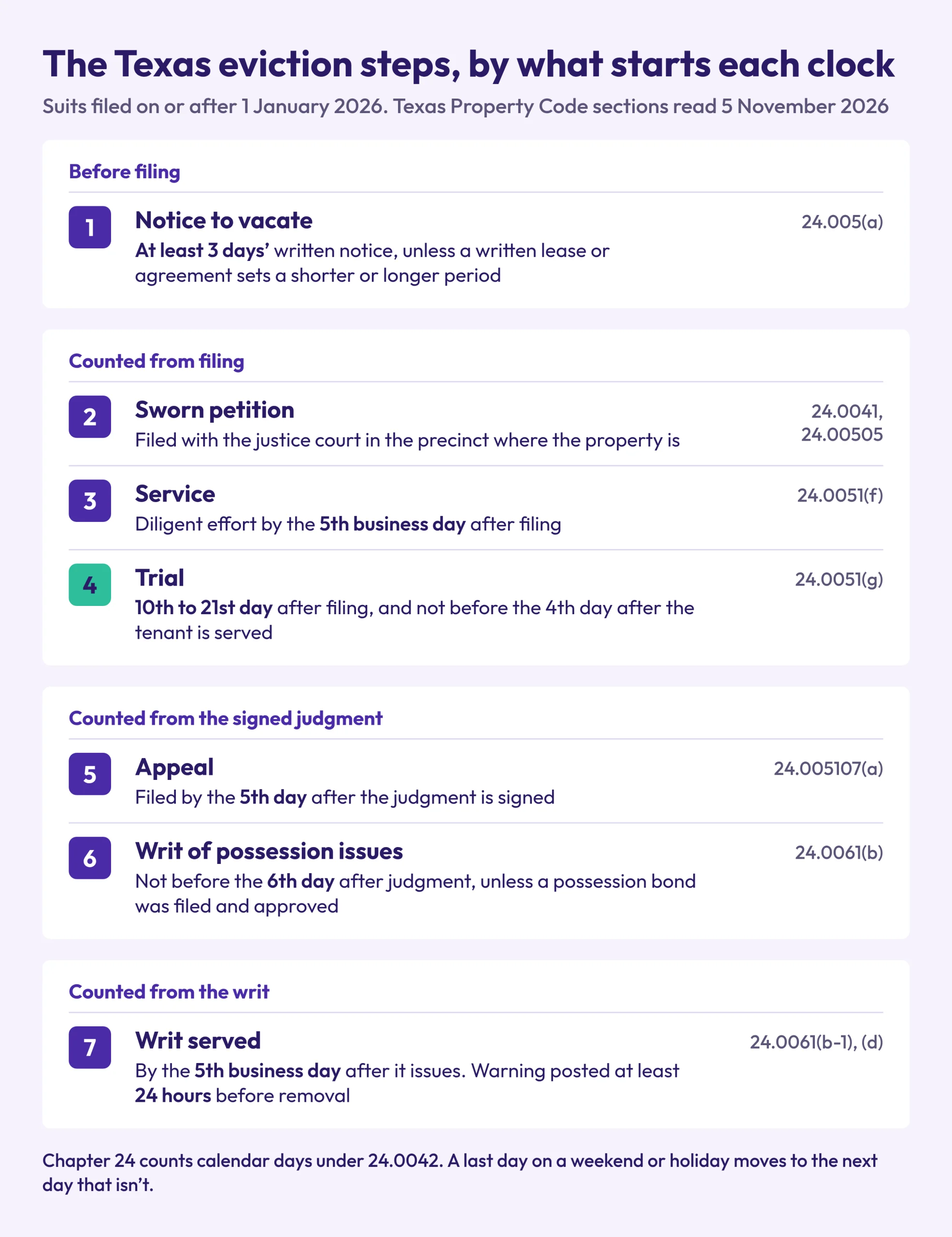
The steps in order
Every Property Code section on this page was read on 5 November 2026 in the Legislature’s current file, which shows amendments through the 2025 sessions.
| Step | What the statute says | Citation (read 5 Nov 2026) |
|---|---|---|
| 1. Notice to vacate | At least 3 days’ written notice before filing, unless a written lease or agreement sets a shorter or longer period | 24.005(a) |
| 2. Sworn petition | Filed with the justice court in the precinct where the property is | 24.0041, 24.00505 |
| 3. Service | Sheriff or constable makes a diligent effort to serve by the 5th business day after filing | 24.0051(f) |
| 4. Trial | Not earlier than the 10th day or later than the 21st day after filing, and not before the 4th day after the tenant is served. No postponement over 7 days unless both sides agree in writing | 24.0051(g) |
| 5. Appeal | Filed by the 5th day after the judgment is signed | 24.005107(a) |
| 6. Writ of possession issues | Not before the 6th day after judgment, unless a possession bond was filed and approved | 24.0061(b) |
| 7. Writ served | By the 5th business day after it issues. Warning posted at least 24 hours before removal | 24.0061(b-1), (d) |
Chapter 24 counts calendar days. Leave out the day of the event that starts the period, count weekends and holidays, and if the last day is a Saturday, Sunday or state or federal holiday, the period runs to the next day that isn’t (24.0042).
Step 1: the notice to vacate
The default is three days, but the lease can change it. Which notice applies depends on why the tenancy is ending (Prop. Code 24.005(a)):
- Unpaid rent, and the tenant wasn’t late before the month of the notice: the notice must be a notice to pay rent or vacate.
- Unpaid rent, and the tenant was late before that month: it may be either a notice to pay rent or vacate or a plain notice to vacate.
- Holding over after the term ends: the landlord must also meet the termination rules in Prop. Code 91.001. A month-to-month tenancy ends on the later of the date in the notice or one month after notice is given, unless both sides signed something different or there’s a breach of the lease (91.001(b), (e)).
The notice must go by at least one of four routes, under 24.005(f-3):
- mail, including first class, registered or certified mail or a delivery service
- delivery to the inside of the premises, in a conspicuous place
- hand delivery to any tenant of the premises who is 16 or older
- e-mail or other electronic means, only if the parties agreed in writing
Taping a notice to the outside of a door isn’t on that list. The list doesn’t apply if the tenant actually receives the notice (24.005(f-4)). The chapter doesn’t say in so many words which day starts the count on a mailed notice, so ask the court before relying on a mailing date.
A landlord who wants attorney’s fees has a separate step unless a written lease already gives them: a written demand sent by registered or certified mail, return receipt requested, at least 10 days before filing, with the wording Prop. Code 24.006(a) requires.
People who broke in or moved in without any agreement are a different track. Oral or written notice is enough for a forcible entry (24.005(d)), and chapter 24B has its own route. Our page on squatters in Texas covers it.
Step 2: the petition and service
The suit goes in the justice precinct where the property sits. Filing in the wrong one means dismissal, and the filing fee isn’t refunded (Rule 510.6(c)). Either side can appear alone or through an authorized agent who need not be a lawyer (Prop. Code 24.011(a)).
Under Rule 510.6 the petition must be sworn. It has to state, among other things, the facts and grounds, when and how notice was given and which kind it was, and the rent due. On a nonpayment-only case it must say whether the tenant was late before the month of the notice.
- Name every tenant. On a written residential lease, name all tenants on the lease who live there and whom the landlord seeks to evict. No judgment or writ can reach a tenant on the lease who wasn’t named and served (Rule 510.6(d)).
- Rent up to $20,000 can be joined, excluding statutory interest and court costs but including attorney fees (Rule 510.6(e)).
- Possession only. The court decides who has the right to possession, not who holds title. Counterclaims and third-party suits aren’t allowed, though they can go in a separate suit (Prop. Code 24.004(c)).
Fees differ by county, and we found no statewide figure. As one example, Travis County Justice Court Precinct 4 lists $144 for filing and service on one person, $90 for each added person, and $205 for a writ of possession (read 5 Nov 2026). It says the filing total can change with the options chosen. The county’s 2026 justice court fee schedule shows the same $144 ($54 filing, $90 service) and $205. A party who can’t afford the fees can file a Statement of Inability (Rule 510.7).
If the sheriff or constable hasn’t served the papers by the 5th business day, the landlord may, but doesn’t have to, use another trained law enforcement officer, including an off-duty one (24.0051(f)). After failed attempts, a judge can authorize delivery to the premises plus first class mail, on the conditions in Rule 510.8(e).
Which court rule text applies
The statute leaves the details to Rule 510 of the Texas Rules of Civil Procedure, rewritten as a stand-alone eviction rule. The Supreme Court’s amended order of 31 December 2025 (Misc. Docket No. 25-9105) gave it preliminary approval, effective 1 January 2026, and took comments to 1 February 2026, saying more changes could follow. We read that order and the clean copy Harris County’s justice courts post, marked as updated to 1 January 2026, on 5 November 2026. The Texas Register’s contents pages for 2026, through the latest issue listed (23 October), show no later order on Rule 510. The compiled rules the Texas Judicial Branch posts, read 6 November 2026, show the same Rule 510 text on every point this page uses, but the file carries no date. Ask the justice court for the current rule, and read rule numbers on this page with that in mind.
Step 3: trial and judgment
A tenant doesn’t have to file a written answer, but may, up to the trial day (Rule 510.11). The tenant does have to appear. If a tenant neither answers nor appears, and proof of service is on file, the petition is taken as admitted and a default judgment follows (Rule 510.16). The citation must carry that warning (24.0051(c)).
Either side can ask for a jury, in writing, at least 3 days before trial or 3 days after service, whichever is later, with the jury fee or a Statement of Inability (Rule 510.15(c)). If the parties agree, the court may let them appear by video or phone (24.005105).
Retaliation is a defense in an eviction suit, and so is a rent deduction lawfully made under chapter 92 (Prop. Code 92.335). Other claims under that chapter can’t be joined.
If the landlord wins, the judgment covers possession, costs, rent owed to that date and attorney fees if the law allows them (Rule 510.18(d)). In a residential case it also states the rent to be paid during any appeal. Rent can still be recovered if the tenant moved out after the petition was filed (24.0051(b)). After a default, the landlord must give the clerk the tenant’s last known e-mail and mailing address, serve the judgment (by e-mail if one is known) and file a certificate of service (Rule 510.16(b)). The clerk sends the judgment too (Rule 510.16(c)), and the statute has the court mail a copy to the premises within 48 hours of a default or summary disposition judgment (24.0061(c)).
Summary disposition
SB 38 added judgment without trial in some cases. Section 24.005106(a) says a landlord that files a sworn petition “alleging a forcible entry and detainer under Section 24.00505” may include a sworn motion for summary disposition. A tenant who gets one has until the 4th day after service to file a response with supporting facts and documents, and the citation must say so in bold on its first page (24.0051(e)). The court may consider a late response filed before judgment if it shows a genuine dispute (24.005106(b)). Rule 510.10 sets out one path for forcible entry and detainer and another, under Rule 503.2, for forcible detainer only. Which one fits a case is a question for the court or a lawyer.
Step 4: appeal to county court
Either side can appeal by filing a bond, a cash deposit or a statement of inability to afford court costs with the justice court by the 5th day after the judgment is signed (24.005107(a) and Rule 510.19). A tenant who appeals must affirm under penalty of perjury a good-faith belief in a meritorious defense and that the appeal isn’t for delay. A landlord can contest a tenant’s statement of inability within 5 days of its filing (24.0052(d)).

In a residential case, a tenant who appeals pays one rental period’s rent into the court registry within 5 days of filing the appeal, then rent at the start of each rental period (24.0053(a-2)). The judgment sets the amount (24.0053(a)). With no rental agreement, the court sets it at the greater of $250 or fair market rent, if the court determines one. Where a government agency pays part of the rent, the tenant pays only the share the court sets (24.0053(b)).
If rent isn’t paid into the registry and the court gave the required written notice, the court on request must immediately issue a writ, without a hearing (24.0054(a)). The county court holds a new trial within 21 days after it receives the papers (24.005107(c)).
Step 5: the writ of possession
With no appeal, the landlord asks for the writ and pays for it. The statute says not before the 6th day after judgment (24.0061(b)). Rule 510.18(g) says the 6th day or the day after the appeal deadline, whichever is later, and sets outer limits: no writ more than 60 days after the judgment is signed (90 for good cause), and no execution after the 90th day. A landlord who filed a possession bond that the judge approved under Rule 510.9 can get a writ sooner, on the conditions there, including notice of the bond served on the tenant at least 7 days before.
Issuing the writ is a ministerial act: the court can’t review or delay it (24.0061(b-1)). The officer then:
- posts a written warning, at least 8½ by 11 inches, on the outside of the front door, giving a date and time at least 24 hours away
- delivers possession to the landlord, tells everyone to leave and physically removes anyone who doesn’t, and may use reasonable force
- has belongings placed outside at a nearby spot, not blocking a sidewalk or street and not while it’s raining, sleeting or snowing
- may use a bonded or insured warehouse at no cost to the landlord, and can’t require the landlord to store anything
If the writ isn’t served by the 5th business day after it issues, the landlord may have it served by another trained officer, including an off-duty one (24.0061(b-1)). Under Rule 510.18(g)(5), that starts with a request to the court for a replacement writ.
How long it takes
No Texas statute we read sets an overall timeline. This is our own illustration of the earliest path, not a promise: a tenant served promptly, no lease change to the notice period, no federal notice, no summary disposition, no possession bond, no postponement, no appeal, and a court with an open trial date. Our page on how long evictions take compares states.
| Step | Example date | Why |
|---|---|---|
| Notice hand-delivered | Mon 9 Nov 2026 | Day 0 is left out |
| Third day | Thu 12 Nov | Veterans Day on Wednesday still counts |
| Petition filed | Fri 13 Nov | After the notice period ends |
| Earliest trial | Mon 23 Nov | 10th day after filing |
| Latest trial | Fri 4 Dec | 21st day after filing |
| Appeal deadline after a 23 Nov judgment | Mon 30 Nov | 5th day is a Saturday, so it moves to Monday |
| Earliest writ | Tue 1 Dec | Day after the appeal deadline, later than the 6th day |
| Earliest removal | Wed 2 Dec | Only if the warning is posted on 1 Dec. The officer has until Tue 8 Dec to serve the writ |
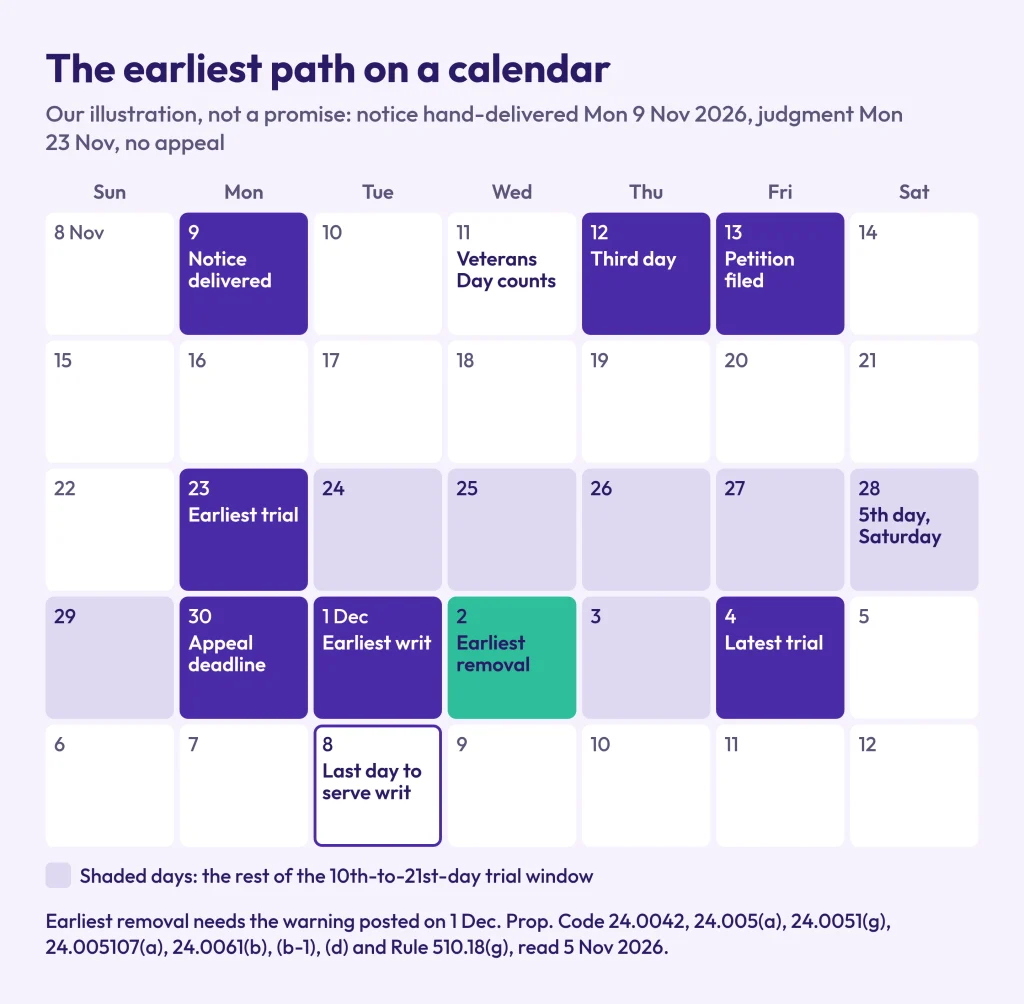
Later service pushes the trial, because it can’t fall before the 4th day after service. An appeal adds the county court steps above.
When federal law or a sale adds time
Texas now separates filing from removal. If federal law requires notice before a tenant has to leave, a landlord who meets the state notice rule doesn’t have to delay filing and the court can’t pause the suit for it, but the writ can’t be served until the time since the notice equals the federal period (24.005(c-1), added by SB 38).
- CARES Act, 30 days. 15 U.S.C. 9058(c) says the lessor of a covered dwelling may not require a tenant to vacate until 30 days after a notice to vacate. Covered properties include federal housing programs and federally backed mortgages, so a small landlord can be covered. Courts disagree on whether this survives and how far it reaches: Arizona’s Court of Appeals held on 12 June 2026 that it has expired, while saying most state courts have held otherwise. The Texas Justice Court Training Center told Texas justice courts in an update dated 1 April 2026 that it still applies to covered dwellings. Searches on 5 November 2026 found no Texas appellate ruling, which isn’t proof there is none.
- HUD public housing and project-based properties. HUD’s 2024 rule requires written notice at least 30 days before an eviction for nonpayment is filed, and bars filing if the tenant pays the rent owed within those 30 days. That wait comes before filing, not only before removal. The current federal rules still show it (24 CFR 247.4(c) and 966.4(q) and (r), read 6 November 2026). HUD moved to revoke the rule on 26 February 2026, then delayed that revocation indefinitely on 13 March 2026, before it took effect, and said it would treat it as a proposed rule. We found no later final rule as of 6 November 2026. The training center’s April update says the uniform notice ended on 30 March, which doesn’t match the Federal Register. How 24.005(c-1) fits with this rule is a question for a lawyer, HUD or the housing provider.
- Servicemembers. Under 50 U.S.C. 3951, a servicemember or dependents can’t be evicted from a home during military service without a court order if the monthly rent is at or under a ceiling, $10,542.60 for 2026, and the court can stay the case.
- After a foreclosure sale under a superior lien. A purchaser who chooses not to continue the lease of a residential tenant who pays on time and isn’t otherwise in default must give at least 30 days’ written notice (24.005(b)). Separately, the federal Protecting Tenants at Foreclosure Act (note to 12 U.S.C. 5220) gives a bona fide tenant at least 90 days’ notice to vacate from the immediate successor after a foreclosure, and a bona fide lease generally runs to its end unless the unit is sold to someone who will live there.
What a landlord can’t do outside court
Texas doesn’t ban every lockout flatly. Prop. Code 92.0081(b) says a landlord may not intentionally keep a tenant out except by judicial process, then lists narrow exceptions. One is changing the locks for delinquent rent, which comes with strict written conditions, including a lease term, advance notice and a new key at any hour whether or not the tenant pays. Because the tenant gets the key either way, this doesn’t end a tenancy or replace the steps above. Read the section and ask a lawyer first.
- Lockout violations: the tenant may recover possession or end the lease, and recover one month’s rent plus $1,000, actual damages, court costs and attorney’s fees, less rent owed (92.0081(h)), plus another month’s rent if the landlord withholds the new key (92.0081(i)). Lease clauses waiving this are void (92.0081(j)).
- Doors, locks and furnishings: removing them is barred unless it’s for a genuine repair or replacement (92.0081(a)).
- Utilities: no interruption except for genuine repairs, construction or an emergency, with a separate process for some submetered electricity. The remedy is similar (Prop. Code 92.008).
- Retaliation: a landlord can’t file an eviction in retaliation within six months after a tenant’s protected act, such as a repair request or a code complaint, apart from the grounds in 92.332, which include unpaid rent (92.331).
Our Texas landlord and tenant law page covers deposits, repairs, late fees and entry.
Units and cities
The eviction steps in chapter 24 don’t change with how many units a landlord owns. One narrow difference: in an appeal for nonpayment, an owner of a multifamily property may use a non-lawyer agent (24.011(b)). Other Texas rules do turn on unit counts: a late fee is treated as reasonable at up to 12% of rent in a building of four or fewer units and 10% in larger ones (Prop. Code 92.019). Our page on rules that change with unit count sorts these out.
Only the Legislature may modify or suspend chapter 24’s procedures, apart from limited disaster orders (24.0043), and a court’s local rules can’t add petition content or require mediation before trial (24.00506(b)). We didn’t survey city ordinances. Ask the justice court whether anything local applies.
What older pages still say
You may see these on older or seller pages. We looked for each in chapter 24 on 5 November 2026 and didn’t find it.
- Service at least 6 days before the hearing. The statute’s limit is the 4th day after service.
- The constable executes the writ within 7 days. The statute says served by the 5th business day after it issues.
- Three days means 72 hours. The chapter counts days, not hours.
- Post the notice on the door. The outside of a door isn’t on the delivery list above.
When to stop and get a lawyer
A landlord should stop and get legal advice before going further if:
- the property has a federal subsidy, voucher or federally backed mortgage
- the tenant or a household member may be on active military duty
- the tenant has raised repairs, a code complaint or retaliation
- the tenant has appealed, or there’s no written lease
- the plan involves locks, utilities or belongings
A tenant facing eviction has short deadlines. The citation names the court and the trial date, and the court can say what it needs. The citation itself gives the State Bar’s line, 1-877-9TEXBAR, for help locating a lawyer and says free or low-cost help may be available. TexasLawHelp’s directory lists legal aid by area. Our page on paying rent after a notice explains what to ask.
Next step: landlords, read the notice clause in the lease, then ask the justice court in the property’s precinct for its petition form, current fees and current rule. Tenants, check the trial date on the citation today and call the court or legal aid. Don’t wait for the hearing, and don’t miss it.
Sources checked on 6 November 2026.
Sources
- Texas Property Code ch. 24, Forcible Entry and Detainer (amendments through Acts 2025; read 5 Nov 2026)
- Texas Property Code ch. 92, Residential Tenancies (read 5 Nov 2026)
- Texas Property Code ch. 91, Provisions Generally Applicable to Landlords and Tenants (read 5 Nov 2026)
- Texas Senate Bill 38, 89th Legislature, enrolled text
- Supreme Court of Texas, Misc. Docket No. 25-9105, Amended Order Giving Preliminary Approval of Amendments to Rule 143a and Part V, 31 Dec 2025, in the Texas Register, 16 Jan 2026
- Texas Register, 2026 issue archive, contents pages read through the 23 Oct 2026 issue
- Texas Rules of Civil Procedure, Part V including Rule 510, copy posted by Harris County Justice Courts, marked updated as of 1 Jan 2026
- Texas Rules of Civil Procedure, compiled by the Texas Judicial Branch (undated file, Rule 510 read 6 Nov 2026)
- Harris County Justice Courts: Eviction Cases
- Travis County Justice of the Peace Precinct 4: Evictions
- Travis County 2026 JP Civil Fee Schedule
- 15 U.S.C. 9058, CARES Act (2024 edition)
- Barrera v. Sedona Pointe LLC, Arizona Court of Appeals, 12 Jun 2026
- Texas Justice Court Training Center: 4.1.2026 TJCTC Updates
- HUD: 30-Day Notification Requirement Prior to Termination of Lease for Nonpayment of Rent, 13 Dec 2024
- HUD: Revocation of the 30-Day Notification Requirement; Indefinite Delay of Effective Date, 13 Mar 2026
- eCFR: 24 CFR 247.4, Termination notice (current text, read 6 Nov 2026); see also 24 CFR 966.4(q), (r)
- Protecting Tenants at Foreclosure Act, note to 12 U.S.C. 5220 (2024 edition)
- 50 U.S.C. 3951, Servicemembers Civil Relief Act (2024 edition)
- Federal Register notice of the 2026 SCRA rent ceiling, doc. 2026-04689
- TexasLawHelp.org: Legal Help Directory