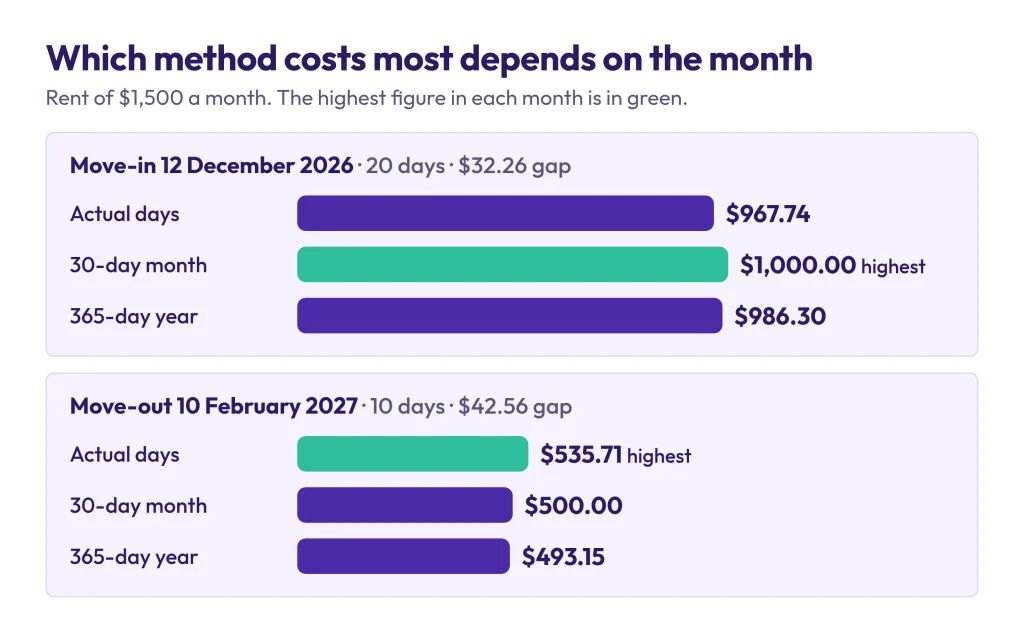
To prorate rent, divide the monthly rent by the days in that month, then multiply by the days being charged. At $1,500 a month, a tenant who moves in on 12 December 2026 is charged for 20 of 31 days: $967.74. The same move comes to $1,000.00 on a 30-day month and $986.30 on a 365-day year. All three are ordinary arithmetic. Your lease usually decides which applies, and in Minnesota the law decides for a final partial month: actual calendar days, with no waiver (Minn. Stat. 504B.116, read 5 November 2026).
This page is general information, not legal or tax advice. Landlord and tenant law varies by state and city, and changes. Ask the court, your state agency, a lawyer or legal aid about your case.
This tool belongs with our guides to rent, raises and late fees. The calculator on this page gives an estimate by all three methods side by side, so you can see what the choice is worth before anyone signs or pays. It works in calendar months, covers a move-in or a move-out, and handles February in a leap year.
The three methods, worked out
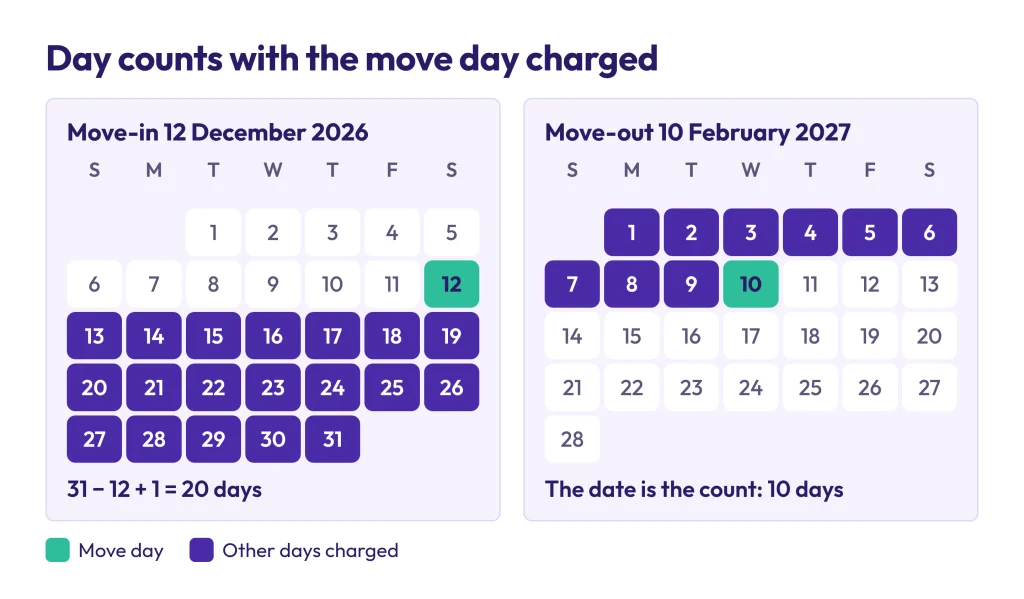
Each method only changes the daily rate. Here is the same example, $1,500 rent and a move-in on 12 December 2026, counting the move-in day. That is 31 minus 12 plus 1, or 20 days.
| Method | Daily rate | 20 days | How it works |
|---|---|---|---|
| Actual days in the month | $1,500 ÷ 31 = $48.39 | $967.74 | The rate changes each month. A full month always comes to exactly one month’s rent. |
| 30-day month | $1,500 ÷ 30 = $50.00 | $1,000.00 | The same rate all year. Also called a banker’s month. |
| 365-day year | $18,000 ÷ 365 = $49.32 | $986.30 | A year’s rent over a year’s days, 366 in a leap year. The same rate all year. |
The gap here is $32.26. It can grow when the month is short: a tenant leaving on 10 February 2027 at the same rent owes $535.71, $500.00 or $493.15. That’s $42.56 between the highest and lowest, and the order flips: the 30-day month was highest in December, and actual days are highest in February. No method always favors one side.
Keep the full decimal until the last step. If you round the daily rate first, $48.39 × 20 gives $967.80, six cents off. The calculator here rounds only the final amount.
Count the days the right way
- Move-in: days in the month, minus the move-in date, plus 1. Moving in on the 20th of a 30-day month is 11 days, not 10.
- Move-out: the move-out date is the day count. Leaving on the 10th is 10 days.
- The move day itself: the calculator charges for it unless you untick the box, and a lease can say otherwise. Without the move day, the December example is 19 days and $919.35.
- A stay inside one month: multiply the daily rate by the days of the stay. The calculator assumes the stay reaches the first or last day of the month.
- Rent due on another date: if rent runs from the 15th to the 14th, the period to count is that one, and this calculator’s calendar months won’t fit. Some leases avoid proration altogether by starting each rent period on the move-in date.
Two traps in the 30-day method
The 30-day rate doesn’t fit months of 28 or 31 days, and that shows at the edges. In a 31-day month, a tenant charged for 31 days at 1/30 would owe more than a month’s rent, so the calculator stops at one month’s rent. That means moving in on the 1st or the 2nd costs the same. In February 2027, moving in on the 1st costs the full $1,500, while moving in on the 2nd is 27 days at $50, or $1,350: one day later, $150 less. If a lease uses a 30-day rate, a line saying how it treats these months heads off the argument. Some leases also count every month as 30 days, which gives a different day count; check the wording before relying on any calculator.
Which method applies
The lease comes first, unless a statute overrides it. We found no federal rule that sets a method for ordinary rentals. Some pages say no state has a law on this, and others say a state requires proration across the board. Neither matched what we read. We searched the statutes below for words about dividing rent by the day. You may also see pages say California uses a 30-day month. We looked for a primary source and didn’t find one: the California sections below set no day count.
| State | What we read, 5 November 2026 | Citation |
|---|---|---|
| Minnesota | When a residential lease term ends before the last day of the final month, rent “must be prorated at the average daily rate for that month”, using actual calendar days. It covers leases that require last month’s rent in advance. A waiver is void. It applies to leases entered into on or after 1 September 2021. Separately, a written lease that requires a move-in or move-out on a date other than the first or last of the month, where rent is prorated, must show the prorated amount for those months on its first page. | Minn. Stat. 504B.116; 1Sp2021 c. 8, art. 2, s. 11; 504B.146 |
| Florida | “Unless otherwise agreed”, rent “is uniformly apportionable from day to day.” | F.S. 83.46(1) |
| Arizona | “Unless otherwise agreed, rent shall be uniformly apportionable from day-to-day.” | A.R.S. 33-1314(C) |
| Kansas | “Unless otherwise agreed, rent shall be uniformly apportionable from day-to-day.” | K.S.A. 58-2545(c) |
| South Carolina | “Unless otherwise agreed, rent is uniformly apportionable from day to day.” | S.C. Code 27-40-310(c) |
| California | When a month-to-month tenancy is ended by notice, rent is “due and payable to and including the date of termination”. Separately, when a hiring ends before the agreed time, the hirer “must pay the due proportion of the hire for such use as he has actually made of the thing”, unless the use was merely nominal and of no benefit. That section dates from 1872 and covers hiring in general. Neither sets a day count, and we did not read case law on how they apply to rent already paid. | Civ. Code 1946(a); 1935 |
| Texas | When a month-to-month tenancy ends on a day that isn’t the start or end of a rent period, the tenant “is liable for rent only up to the date of termination”. That rule doesn’t apply where both sides signed an agreement setting a different notice period or saying no notice is needed, or where there is a breach of contract recognized by law. It sets no day count. Chapter 92 also gives a pro rata refund in listed cases, such as a casualty loss that ends the lease or a revoked certificate of occupancy. | Prop. Code 91.001(d), (e); 92.054(b), 92.023 |
| Washington | Chapter 59.18 sets no general rule that we found. It gives a pro rata refund of prepaid rent in listed cases, such as a tenant who leaves over an unrepaired defect. | RCW 59.18.090(1) |
| Virginia | The section on rent says when it is payable and has no day-to-day sentence. We read that section, not the whole chapter. | Va. Code 55.1-1204(D) |
| Every other state | Not confirmed. Ask the court or state agency. | None read for this page |
Those day-to-day sentences have limits. “Unless otherwise agreed” means a lease can change them. None of them says whether to divide by 30 or by the actual month. And none of them says a tenant who leaves early gets money back: we did not read court decisions on that. City rules can add to any row. Minnesota’s section speaks of the final month only. A 2026 bill, HF 4443, would add an incomplete first month; the Revisor’s 2026 statutes, read 5 November 2026, don’t show that change.
Does a landlord have to prorate?
Minnesota’s final-month rule and the month-to-month rules in Texas and California come closest to a flat yes. The other statutes we read don’t give one. It depends on which month it is and how the tenancy ends.
First month. The move-in date and the first payment are lease terms. If a lease starts on the 12th and says rent is a monthly sum due on the 1st, the first payment is whatever the lease says it is. That amount is the thing to settle before signing.
Last month of a month-to-month tenancy. Notice rules often decide whether a partial month exists at all. As read on 5 November 2026, notice comes 30 days before the end of a monthly period in Florida, 30 days before the periodic rental date in Arizona, and 30 days before the next rent due date in Virginia unless the agreement differs. A Washington tenant gives notice of 20 days or more preceding the end of a month or period. In Texas, a tenancy ends on the later of the date in the notice or one month after it, unless a signed document differs, so it can end mid-month, with rent owed only up to that date. California’s Department of Real Estate guide tells tenants they “must pay full rent during the period covered by the notice”. Its example: notice on 10 September, rent through 10 October. It adds that a tenant may owe less if the unit is re-rented and the new tenant starts paying within that time. Our guide to the 30-day notice to vacate covers the notice itself.
End of a fixed-term lease. If the term ends on the 18th, whether the last rent stops on the 18th turns on the lease and state law. Minnesota’s statute divides it. Elsewhere, start with the lease and your state’s row above. If a tenant stays past the end date, that is a different question: see holdover tenants.
Leaving early. Moving out before the term or notice ends may not stop the rent. That turns on the lease, the state and whether the unit is re-rented, and proration only comes in once something fixes an end date. Our page on the cost of breaking a lease goes through that.
Military moves and Section 8
One federal rule does name proration. When a servicemember ends a lease under the Servicemembers Civil Relief Act, unpaid rent for the period before the effective date is paid on a prorated basis, no early termination charge may be imposed, and rent paid in advance for later periods goes back within 30 days of that date. Charges under the lease, such as reasonable excess wear, can still be owed. See 50 U.S.C. 3955(e) and (f). Under a monthly lease, the end date is 30 days after the first rent due date following delivery of the notice, so it can fall partway through a month. States can add their own rule. As read on 5 November 2026, Florida’s section also makes a servicemember liable for rent prorated to the termination date, and that section can’t be waived.
In the voucher program, federal rules work differently for the housing authority’s share. After a family moves out, the authority can’t pay for any later month, and the owner “may keep the housing assistance payment for the month when the family moves out” (24 CFR 982.311(d)). We read nothing that sets how a family’s own share is divided, so ask the housing authority, and see our Section 8 guide.
What gets collected at move-in
A lease can handle a partial first month in at least two ways. Either the prorated amount is due at move-in and full rent starts on the 1st, or a full month is paid at move-in and the difference is settled against the next month. Late in a month, the first way can stack up: at $1,500, a move-in on 28 December 2026 is 4 days, or $193.55, plus $1,500 for January if both are collected together.
That matters in states that limit what can be taken up front. As read on 6 November 2026, California counts “an advance payment of rent” as security under Civ. Code 1950.5(b), and subdivision (c) limits security to one month’s rent “in addition to any rent for the first month paid on or before initial occupancy”. The cap is two months for a landlord who is a natural person, or an LLC whose members are all natural persons, owning no more than two residential rental properties with no more than four units offered for rent between them, except when the tenant is a service member; there are other exceptions too. Massachusetts lets a landlord require no more than listed items at the start, including “rent for the first full month of occupancy” (c.186 s.15B(1)(b), in the Trial Court libraries’ unofficial copy, last updated 30 June 2025, read 6 November 2026). We did not find how either treats a partial month plus a full one. If that is your plan, ask a lawyer or legal aid before collecting it.
A prorated first or last payment can also affect late fees, since a fee rule may turn on when that payment was due. Our page on rent late fees has the state rules we read.
What a lease should settle
This isn’t wording to copy. These are the questions that cause disputes when a lease is silent:
- Does rent get prorated, and in which months: first, last or both?
- Which method: actual days, a 30-day month or a 365-day year?
- Is the move day charged, and which side pays for it?
- What is the dollar amount for the first partial month, and when is it due?
- Are pet rent, parking and other monthly charges prorated too? If so, add them to the calculator’s second field.
- If a tenant has prepaid a full month, how and when does any difference come back?
Your next step
Run your dates through the calculator, then find the proration line in your lease. If the lease names a method, that’s the figure to look at. If it doesn’t, the three results show what’s at stake, and any agreed amount is easier to prove in writing. In Minnesota, check a final partial month against actual calendar days. If you and the other side disagree on an amount that matters, or an eviction notice is involved, don’t wait: ask the court, your state agency, or a lawyer or legal aid.
The calculator gives an estimate. It doesn’t say what you may charge or what you owe.
Sources checked on 6 November 2026.
Formulas and sources
- Monthly amount being prorated: Arithmetic on the reader's own entries, no outside figure
- Days in that month: Minn. Stat. 504B.116(b): prorated rent uses actual calendar days in the month
- Days in that year: Arithmetic on the reader's own entries, no outside figure
- Days charged: Arithmetic on the reader's own entries, no outside figure
- Daily rate, actual days: Minn. Stat. 504B.116(b): prorated rent uses actual calendar days in the month
- Daily rate, 30-day month: Arithmetic on the reader's own entries, no outside figure
- Daily rate, 365-day year: Arithmetic on the reader's own entries, no outside figure
- Estimate by actual days in the month: Minn. Stat. 504B.116(b): prorated rent uses actual calendar days in the month
- Estimate by 30-day month: Arithmetic on the reader's own entries, no outside figure
- Estimate by 365-day year: Arithmetic on the reader's own entries, no outside figure
- Gap between highest and lowest: Arithmetic on the reader's own entries, no outside figure
- Rest of the month by actual days: Arithmetic on the reader's own entries, no outside figure
Sources
- Minn. Stat. 504B.116, Prorated rent required
- Minnesota Laws 2021, 1st Special Session, chapter 8
- Minn. Stat. 504B.146, Lease duration notice
- Minnesota HF 4443, 2026 bill
- Florida Statutes 83.46
- Florida Statutes 83.57
- Florida Statutes 83.682
- Arizona Revised Statutes 33-1314
- Arizona Revised Statutes 33-1375
- Kansas Statutes 58-2545
- South Carolina Code, Title 27, Chapter 40
- California Civil Code 1946
- California Civil Code 1935
- California Civil Code 1950.5
- California Department of Real Estate, moving out guide
- Texas Property Code chapter 91
- Texas Property Code chapter 92
- RCW 59.18.090
- RCW 59.18.200
- Code of Virginia 55.1-1204
- Code of Virginia 55.1-1253
- Massachusetts G.L. c.186 s.15B, Trial Court Law Libraries copy
- 50 U.S.C. 3955, Servicemembers Civil Relief Act
- 24 CFR 982.311