Sometimes. Under the rules we read, a landlord can deny an emotional support animal when no disability-related need is shown, when that specific animal is a direct threat or would cause substantial damage, or when the request is an undue burden. The risky assumption is that a 2026 HUD memo made every untrained animal refusable. HUD changed how it enforces the Fair Housing Act, not the Act, and several states say their own laws still cover untrained animals.
This page is general information, not legal or tax advice. Landlord and tenant law varies by state and city, and changes. Ask the court, your state agency, a lawyer or legal aid about your case.
This guide is part of Becoming a Landlord. It’s written first for small landlords, and tenants can use it to check a refusal. This area is moving, so everything below is dated.
What HUD changed
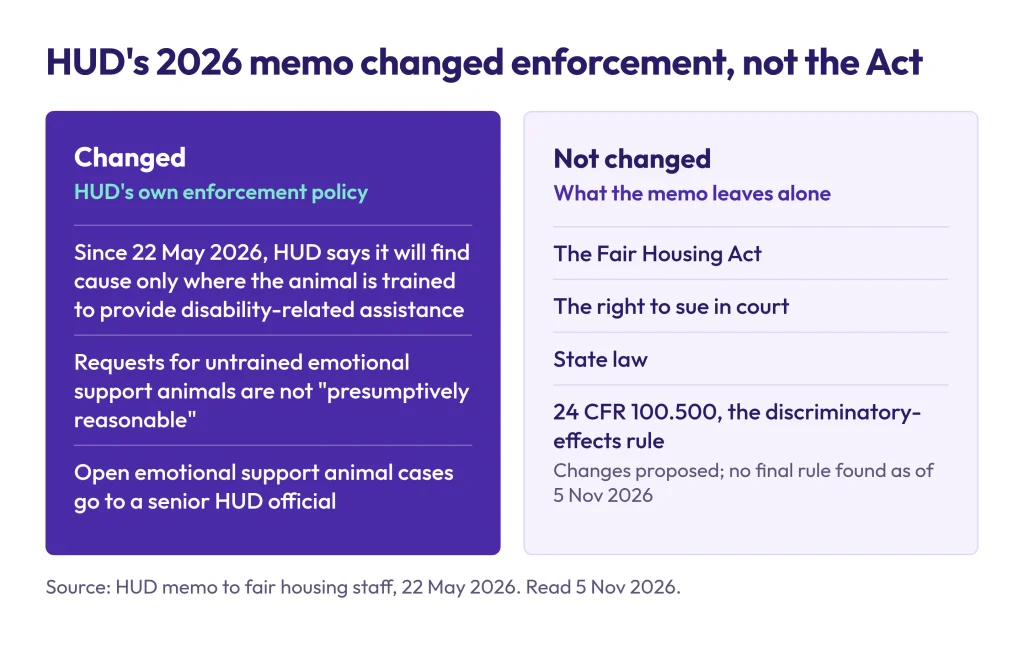
HUD withdrew its assistance-animal notices (FHEO-2020-01 and 2013-01) in a notice published 6 April 2026, effective 17 September 2025, saying they “should not be relied upon as authoritative.” Since 22 May 2026, under a memo to its fair housing staff, HUD says it will find cause in animal cases only where the animal is trained to provide disability-related assistance:
Effective immediately, for complaints related to animal-related reasonable accommodations, FHEO will find reasonable cause and recommend charges only for those cases involving animals trained to provide disability-related assistance.
That is HUD’s enforcement policy, not a change in the Fair Housing Act. HUD itself says the memo doesn’t affect a person’s right to sue: “Nothing in this enforcement guidance affects the rights of parties to seek redress through a private action in court.” State law is unchanged by it. So is 24 CFR 100.500, HUD’s separate discriminatory-effects rule; HUD has proposed changes to that rule, and we found no final rule as of 5 November 2026.
The memo also says:
- Requests to waive a pet policy for trained animals are “presumptively reasonable,” and requests for untrained emotional support animals “are not.” Not presumed reasonable is different from never reasonable.
- HUD’s fair housing office “no longer expects housing providers to categorically extend accommodations for trained assistance animals to untrained ESAs.”
- Open emotional support animal cases go to a senior HUD official for case-by-case decisions.
- It doesn’t address complaints under Section 504 or the Americans with Disabilities Act.
- HUD says it intends to write a rule.
The memo is a direction to staff, not a regulation. HUD’s own withdrawal notice says guidance “is non-binding and does not create substantive rights.” That cut against the old notices, and it’s a reason not to treat this memo as the law either.
Emotional support or trained?
The label doesn’t settle this. HUD’s test is whether the animal is “individually trained to perform work or perform tasks directly related to the complainant’s disability.” That wording is borrowed from the ADA’s service animal rule, and a mental health condition can qualify: the rule’s examples include helping people with psychiatric and neurological disabilities. Comfort alone doesn’t count. The rule says “the provision of emotional support, well-being, comfort, or companionship do not constitute work or tasks.”

Two limits on that test. HUD’s memo says a housing accommodation could involve a species other than a dog, if the animal is trained, which the ADA’s service animal definition doesn’t include. And the memo doesn’t say what proof of training a landlord may ask for, so a tenant’s statement that a dog is task-trained can’t be sorted out from the memo alone.
What federal courts have said
The Fair Housing Act never mentions animals. It makes it discrimination to refuse “reasonable accommodations in rules, policies, practices, or services” when they “may be necessary” for equal use of a home (42 USC 3604(f)(3)(B)). HUD’s regulation still gives one animal example: a no-pets waiver for a blind applicant’s seeing eye dog (24 CFR 100.204(b)). Courts decide the rest.
- Revock v. Cowpet Bay West (3d Cir. 2017). A reasonable accommodation “may include the use of an emotional support animal in one’s own home,” and the court cited decisions from the First, Sixth and Eleventh Circuits. It added that a landlord “may contest whether the accommodation is reasonable.” HUD’s memo quotes that second line.
- Bhogaita v. Altamonte Heights (11th Cir. 2014). A condominium association demanded removal of an emotional support dog over a weight limit and, after letters from the owner’s psychiatrist, kept asking for more information. The court affirmed $5,000 in damages and $127,512 in attorney’s fees.
- Henderson v. Five Properties (E.D. La. 2025), attached to HUD’s memo. One district court called HUD’s 2020 notice “unpersuasive.” But the landlord there allowed the dog. The dispute was a $400 fee, and the landlord had offered a payment plan. The court also said it wasn’t holding that animal fees “can always be enforced against someone with an ESA.”
Some older decisions leaned on HUD’s notices, which HUD now disowns, but the memo doesn’t overrule any court decision. We found no appeals court ruling on the memo as of 5 November 2026. Nobody can say from this how a given court will rule, and the answer can differ by federal circuit.
Does the federal law reach you?
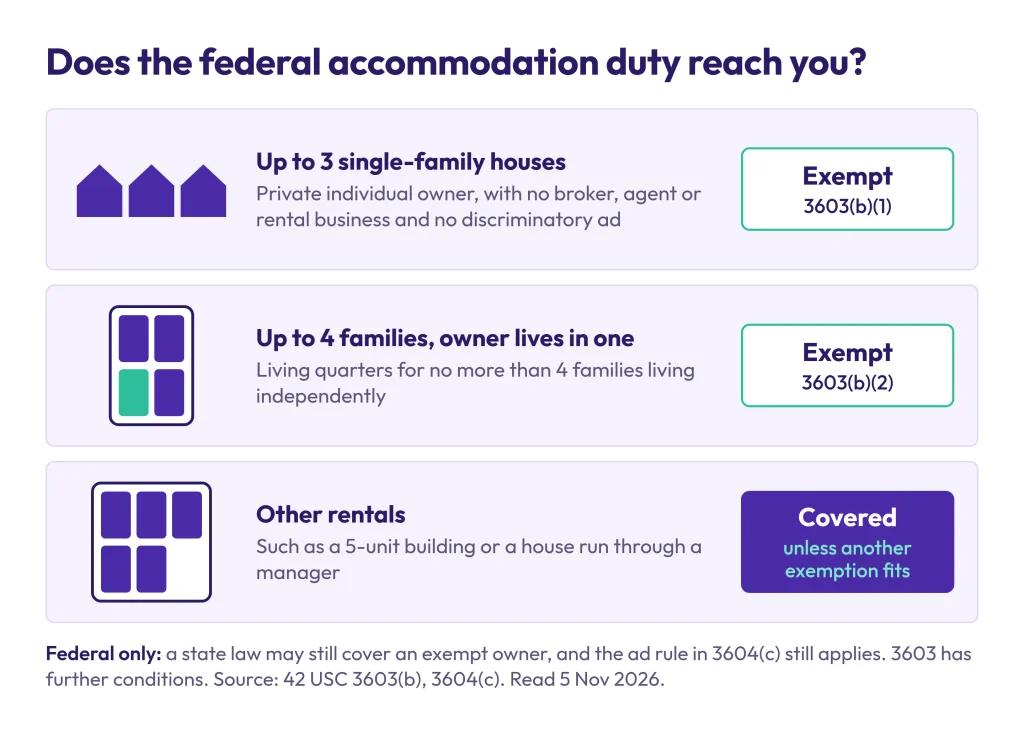
This is where the number of units you own matters. The Act’s rental rules, including the accommodation duty, have two small-owner exemptions in 42 USC 3603(b). More unit-count rules are in our guide to small-landlord rules.
| Your situation | Section 3604, including accommodations |
|---|---|
| Single-family house rented by a “private individual owner” of no more than 3 such houses, with no broker, agent or rental business involved and no discriminatory ad | Exempt, under 3603(b)(1). The section has further conditions, 3603(c) defines who is “in the business,” and using a property manager can end the exemption. Whether a house held in an LLC fits those words is a question for a lawyer |
| Building with living quarters for no more than 4 families living independently, where the owner lives in one | Exempt, under 3603(b)(2) |
| Other rentals, such as a 5-unit building or a house run through a manager | Covered, unless another exemption fits, such as the religious and private club rules in 3607 |
| Exempt owner placing an ad | The ad rule in 3604(c) still applies. It bars ads showing a preference or limitation based on disability |
These exemptions are federal only. State laws draw their own lines, which we didn’t read for this page. An owner exempt under federal law may still be covered by a state law.
State law can go further
The Fair Housing Act doesn’t stop a state from protecting the same rights (42 USC 3615). The table shows only states where we read the statute or the state agency’s own text. It doesn’t show every state with a rule, and each row shows its read date.
| State and source | Untrained emotional support animals | Pet fees and deposits |
|---|---|---|
| California: Legal Alert CRD 2026-01, 20 Jul 2026; agency FAQ, Aug 2026; citing 2 CCR 12005, 12176 to 12185. Read 5 Nov 2026 | State law still requires accommodation “whether or not the animal is trained.” The agency keeps taking complaints | Not allowed: no pet deposit, pet rent or other fee because of the animal |
| Florida: F.S. 760.27, 2026 statutes. Read 5 Nov 2026 | Defined as an animal that “does not require training.” But the section begins “To the extent required by federal law, rule, or regulation.” We found no Florida court or agency reading of those words since the memo | Tenant “may not be required to pay extra compensation” |
| Maine: 5 M.R.S. 4582-A(3), 4553(1-H). Read 5 Nov 2026 | An animal a licensed health professional finds necessary to mitigate a disability’s effects counts, separately from trained animals | “may not be conditioned on the payment of a fee or security deposit” |
| Maryland: Commission on Civil Rights guidance, announced 8 Sep 2026; Md. State Gov’t 20-706(b)(4). Read 5 Nov 2026 | “a change in federal enforcement policy does not eliminate protections provided under Maryland law.” No training needed, but a link between disability and support is | Not allowed, including fees for processing the request |
| Pennsylvania: Human Relations Commission release, 20 Oct 2026. Read 5 Nov 2026 | The Commission’s fair housing director: “ESAs are still fully protected as reasonable accommodations in housing.” The Commission ordered one provider to pay nearly $23,000 for refusal and retaliation: $20,000 damages, $929.23 expenses, $2,000 civil penalty | Not confirmed. Draft guidance is open for comment to 15 Nov 2026 |
| Virginia: Code 36-96.3:1, 36-96.3:2. Read 5 Nov 2026 | An assistance animal may “provide emotional support that alleviates” symptoms or effects of the disability (36-96.3:2(D)) | “shall not be required to pay a pet fee or deposit or any additional rent” (36-96.3:1(A)) |
| All other states | Not confirmed. Ask your state’s civil rights agency | Not confirmed |
Agency guidance isn’t a statute, and California and Maryland both say theirs is not legal advice. Search results point to statements from South Carolina’s and Maine’s commissions too, but we couldn’t open either, so this page relies on neither. Cities and counties may add rules of their own, and we didn’t read those.
Reasons a request can be refused
Each ground below is decided case by case, on the facts of the person and the animal.

| Ground | Source | What the sources say it takes |
|---|---|---|
| No disability, or no disability-related need | 42 USC 3604(f)(3)(B), 3602(h); Va. 36-96.3:2(D) | The accommodation has to be tied to a disability as the Act defines it. Virginia lists both as grounds for denial |
| Direct threat, or substantial damage to others’ property | 42 USC 3604(f)(9); 24 CFR 100.202(d); F.S. 760.27(2)(a) | The federal text speaks of a tenancy; state sources apply this to the animal. Maryland says it can’t rest on stereotypes about breeds, and that such denials are rare. California says “credible and objective evidence.” Virginia’s test is a “clear and present threat of substantial harm” that can’t be reduced by another accommodation. Maine also lets a landlord show the animal would substantially interfere with others’ enjoyment of the housing (5 M.R.S. 4582-A(3)) |
| Undue burden, or a fundamental change to the housing | Va. 36-96.3:2(C), (D); California FAQ; Maryland guidance | Maryland: the burden must be “genuine and substantial” against the provider’s resources. Virginia and Maryland call for a good-faith effort to find an alternative |
| Requested proof isn’t given | Maryland guidance; California FAQ | Maryland: a denial “will likely be permissible” if the person declines. California: if what’s offered falls short, a landlord “cannot simply deny” and must let the person provide other reliable information |
In the state sources we read on 5 November 2026, some common reasons don’t hold up on their own. California bars breed, size and weight limits on emotional support animals, even ones set by an insurer. Maryland treats a rejection based solely on species or breed as generally evidence of discrimination, and says lack of insurance cover will generally not justify a denial unless undue burden is shown. Virginia’s threat test can’t rest solely on breed, size or type, though a substantial rise in the owner’s insurance cost is a factor in its undue-burden test. A no-pets rule isn’t a ground in itself, since a waiver of that rule is usually what’s being requested. We found no federal rule on these points in the text we read, so outside these states the answer is less settled.
More than one animal isn’t an automatic yes or no. Maryland says each request is weighed on its merits. California lets a landlord ask for proof of the need for more than one and consider their total impact, and Florida lets a landlord ask about the need for each animal.
What a landlord can ask for
HUD’s withdrawn 2020 notice described what documents a landlord could ask for. That’s gone, but this part of the regulation stands: 24 CFR 100.202(c) makes it unlawful to ask whether an applicant or resident has a disability, or about its nature or severity, apart from listed questions put to all applicants, a limit that also shapes tenant screening. An accommodation request raises different questions, and Bhogaita said that, generally, housing providers “need only the information necessary to apprise them of the disability and the desire and possible need for an accommodation.” Demands for treatment details hurt the association in that case.
- Disability or need not obvious: Florida, Virginia and California allow a request for reliable information (state sources in the table above, read 5 November 2026). Virginia bars further verification of a disability that is obvious or known.
- Diagnosis and medical records: Florida and Maryland bar asking for them.
- Forms: Florida bars requiring a specific form or a notarized statement.
- Who can write a letter: Maryland looks to a medical provider. California also accepts a credible statement and reliable third parties. Florida allows telehealth providers, with an extra in-person condition for out-of-state providers on proof of disability.
- Online certificates: In Florida a registration or certificate from the internet “is not, by itself, sufficient.” California and Maryland both say online care can be legitimate, so “it came from a website” doesn’t decide it, though Maryland calls denial generally reasonable where the only support is a “rubber stamp” company.
- Questions about the animal: Maryland lists housetraining, size, breed, safety around people and any history of injury. Florida allows proof of licensing and vaccination.
No statute we read sets a number of days to answer. Timing still counts: Bhogaita, quoting a Fifth Circuit case, says “an indeterminate delay has the same effect as an outright denial.” In Maryland a request can come after move-in. HUD’s memo says nothing about revoking an approval already given.
Fees, deposits and damage
No section of the Fair Housing Act we read sets a pet fee rule. The flat ban came from guidance: HUD’s withdrawn 2020 notice, which relied on a 2004 HUD and Justice Department statement whose current status we couldn’t confirm. Henderson rejected it as a blanket rule and called the question “fact-specific.” There the $400 fee was a little under 3% of the housing cost and the tenant said she could have paid in installments. So the federal sources we read give no flat answer either way, while five of the six states in the table do, Florida subject to the opening words noted there.
Damage is different. California, Florida, Maine, Maryland and Virginia all leave the tenant responsible for damage the animal causes, within limits (read 5 November 2026). Virginia ties it to what pet owners would owe, and California excludes ordinary wear and tear. For the deposit side, see what a landlord can charge for cleaning and deposit return deadlines by state. California also bars requiring liability insurance for the animal.
Public and subsidized housing
Section 504 bars disability discrimination in programs receiving federal money (29 USC 794), and HUD’s memo doesn’t address it. HUD’s pet rules for assisted and public housing projects for elderly people and people with disabilities still exclude “animals that are used to assist, support, or provide service to persons with disabilities” (24 CFR 5.303). Whether a voucher payment alone makes a private owner subject to Section 504 is a question we didn’t research, so ask the housing agency or a lawyer. See also becoming a Section 8 landlord.
Claims you may see
- “HUD no longer takes emotional support animal complaints.” The memo limits cause findings and charges. It doesn’t use those words, and it sends open cases for individual review.
- “Landlords can now refuse all emotional support animals.” The memo doesn’t say that, and the states above say the opposite for their own laws.
- “The ADA bars pet deposits for emotional support animals.” You may see this on seller pages. The ADA rule on surcharges covers service animals (28 CFR 36.302(c)(8)), and its definition of a service animal excludes emotional support as a task. We didn’t find the claim in either.
- “The animal must be registered.” We found no federal registry. California says no legal requirement exists to register or certify one.
If it becomes a dispute
A complaint can go to HUD within one year, and HUD refers it first to a certified state or local agency where one has jurisdiction. A person can sue within two years; a court may award actual and punitive damages, and attorney’s fees to the winning side. Those clocks are federal, and state ones differ. Retaliating against someone for using these rights is separately barred (42 USC 3617).
If an eviction case has started over an animal, court deadlines keep running. Tenants: contact the court and legal aid right away. Landlords: this is the point to stop and speak to a lawyer, and the lawful eviction steps still apply.
Your next step
Landlords: before answering a request, look up your state civil rights agency and read what it says about emotional support animals, then check the exemptions above. Ask a lawyer before refusing, or if you plan to change a pet policy because of the HUD memo. Tenants: put the request in writing, keep a copy, and if you’re refused, ask your state agency or legal aid about your state’s law and deadlines. Both sides: watch for HUD’s rule, because this page may change when it appears.
Sources checked on 6 November 2026.
Sources
- HUD: Enforcement Guidance on Requests for the Use of an Animal as a Reasonable Accommodation, 22 May 2026 (with Henderson v. Five Properties attached)
- HUD: Notification of Withdrawal of FHEO Guidance Documents, FR-6571-N-01, published 6 April 2026
- 42 USC 3602, definitions
- 42 USC 3603, exemptions
- 42 USC 3604, discrimination in rental
- 42 USC 3610, complaints
- 42 USC 3613, private suits
- 42 USC 3607, religious organization and private club exemption
- 42 USC 3615, effect on state laws
- 42 USC 3617, interference and retaliation
- 29 USC 794, Section 504
- 24 CFR 100.202
- 24 CFR 100.204
- 24 CFR 5.303
- 28 CFR 36.104, service animal definition
- 28 CFR 36.302, service animal surcharges
- HUD: Disparate Impact proposed rule, 10 August 2026
- Revock v. Cowpet Bay West Condominium Association, 853 F.3d 96 (3d Cir. 2017)
- Bhogaita v. Altamonte Heights Condominium Association, 765 F.3d 1277 (11th Cir. 2014)
- California Civil Rights Department: Legal Alert CRD 2026-01, 20 July 2026
- California Civil Rights Department: Emotional Support Animals and Fair Housing Law FAQ, August 2026
- Florida Statutes 760.27 (2026)
- Maine 5 M.R.S. 4582-A
- Maine 5 M.R.S. 4553
- Maryland Commission on Civil Rights: Guidance on Disability Accommodations Related to Emotional Support Animals
- Maryland Commission on Civil Rights: news release, 8 September 2026
- Maryland Code, State Government 20-706
- Pennsylvania Human Relations Commission: release, 20 October 2026
- Pennsylvania Human Relations Commission: Assistance, Emotional Support, and Service Animal Guidance (draft)
- Code of Virginia 36-96.3:1
- Code of Virginia 36-96.3:2